
If previously the main shipping companies
worldwide containerized ships used their ships on the routes
East-West on the basis of rather long-term programming, with
limited changes in the hold capacity offered in 2025
A real upheaval of this pattern has taken place
consolidated since there has been a significant change
structural. This was revealed by Sea-Intelligence, a
research that analyzes in particular the shipping sector
containerized, based on its own stability analysis
operating on the Asia-North America and Asia-Europe shipping routes that
examined the loss of operational capacity, i.e. -
explained the company - the sum of the total capacity injected and
withdrawn from a variable route - specified Sea-Intelligence -
which highlights the degree of volatility by quantifying
the extent of changes in the use of ships by
of shipping companies.
Sea-Intelligence highlighted that the data for 2025 indicate
a significant structural change, with companies that are
Move from a stable use of container ships to a
Adjustment of the high frequency capacity. The company
found that this trend was more
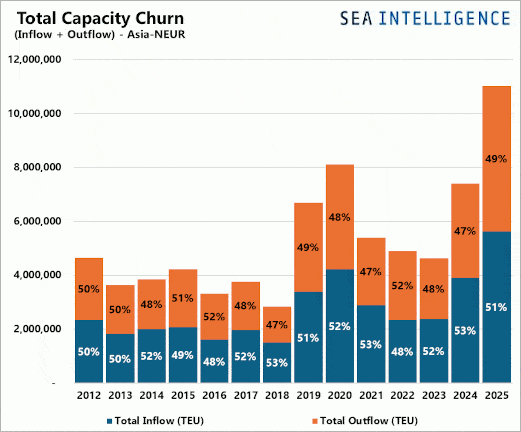
pronounced on the Asia-North Europe route, where in 2025
Hold capacity withdrawal reached 11.0
million TEU containers compared to a historical average of 3-5
million TEUs recorded between 2012 and 2019. The 2025 figure
is +138% higher than in 2023, indicating -
explained the company - that carriers are actively
introducing and withdrawing tonnage at a rate never before seen in
precedence.
If for the Asia-North Europe route the volatility in 2025 is
was extreme, was also evident in relation to
to the Asia-North America and Asia-Mediterranean routes. In particular, the
Pickup rate for the Asia-North West Coast route
America reached a record 10.4 million TEUs, with a
increase of +32% over 2024. The withdrawal rate relative to the route
Asia-Mediterranean reached 6.9 million TEUs, up by
+80% compared to 2023 and +21% compared to 2024. Relatively
to the Asia-East Coast route of North America, in 2025 the rate
of shrinkage remained high at 6.6 million TEUs, although it
recorded a relatively more gradual increase than
to the other routes.
Overall, this data
show that the relative stability of ship deployment
of the pre-pandemic era is over and that the shrinkage rate
on these key routes suggests that the rapid and record pattern of
"cascading buffer", where capacity flows
from primary to
has been replaced by a dynamic system, in which
ships are frequently replaced to accommodate the
fluctuations in short-term demand and to manage the
operational interruptions.



















 - Via Raffaele Paolucci 17r/19r - 16129 Genoa - ITALY


