
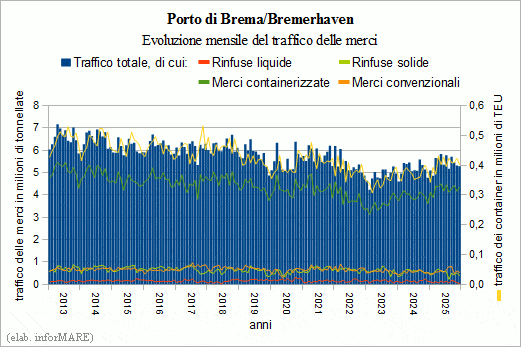
In 2025, the growth of cargo traffic in the port of
Bremen/Bremerhaven has been consistent and even in the last
quarter marked a marked increase of +5.4% on the same quarter
previous year, 16.06 million were handled
of tonnes, of which 8.08 million tonnes at landing (+2.7%)
and 7.98 million tons at loading (+8.2%).
In the fourth quarter of 2025, the overall increase in volumes
of loads, moreover, was driven by an accentuation of
of the growth in containerized traffic, which amounted to
12.93 million tons (+11.8%) and was built
with container handling of 1,243,061 TEUs (+11.0%).
Other miscellaneous goods remained stable with a total of 1.59
million tons (+0.3%), of which 784 thousand tons of rolling stock
(+12.8%), 284 thousand tons of steel products (-15.0%),
112 thousand tons of forest products (0%) and 408 thousand tons
of other miscellaneous goods (-7.7%). The handling of new cars is
was 331 thousand vehicles (+9.5%). Bulk cargo fell sharply, with
liquid waste amounted to 238 thousand tons (-54.8%)
and solid waste at 1.30 million tonnes (-17.2%), including
736 thousand tons of minerals (-14.9%), 91 thousand tons of
food products (+1.1%), 23 thousand tons of coal and coke
(-8.0%) and 693 thousand tons of other dry bulk (-38.2%).
In the whole of 2025, the German port handled 65.28 million
of tons of goods, with an increase of +5.4% on the year
of which 33.82 million tonnes at landing (+6.1%) and
31.45 million tons at embarkation (+4.6%). In the field of
total container traffic was 51.20 million
tons (+8.5%) with a container handling of
4,901,695 TEUs (+10.3%). Other miscellaneous goods amounted to
7.02 million tonnes (+6.9%), of which 2.92 million tonnes
tonnes of rolling stock (+6.4%), 1.64 million tonnes of
steel products (-4.6%), 418 thousand tons of products
forestry (-19.1%) and 2.04 million tonnes of other cargo
(+29,1%). Car traffic was 1.25 million
media (-0.1%). In the liquid bulk sector, traffic is
1.13 million tonnes (-29.8%) and in that of the
dry bulk cargo of 5.92 million tonnes (-9.5%), including 3.12 million tonnes
million tons of minerals (-12.1%), 501 thousand tons of
food products (+24.6%), 77 thousand tons of coal and coke
(-8.3%) and 3.36 million tons of other goods (-18.5%).



















 - Via Raffaele Paolucci 17r/19r - 16129 Genoa - ITALY


