
The port of Taranto cannot shake off its
traditional industrial vocation, despite repeated attempts
of diversification started at least twenty-five years coinciding
with the inauguration of its container terminal at the Pier
Multi-sector
 (
of
2
July 2001). And this vocation is still dominating the recent
fate of the Apulian airport, which is at the mercy of the
bulk volumes, in particular solid bound bulk
to the steel supply chain.
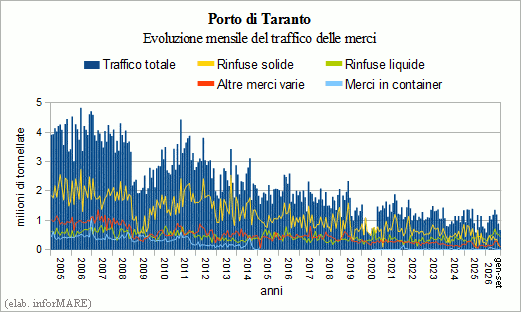
For many years, dry bulk cargo dominated the
scene. Lately, it is the liquid ones that support the activity
of the port. The crisis in the steel sector linked to the former Ilva is
in fact, continuing to have a strong impact on the Apulian airport
which in the third quarter of this year recorded a
of 2.76 million tons of goods, with a total of
increase of +9.1% over the same period of 2025 attributable in
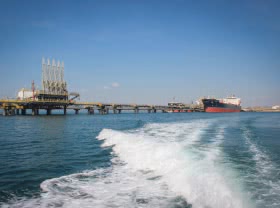
to the growth of liquid cargoes. The latter sector is
driven by the volumes of petroleum products from the local refinery
Eni and crude oil from the Lucanian Tempa field
Red, and closed the July-September period of 2026 with 1.51
million tons (+15.6%). Dry bulk cargo, on the other hand,
despite the increase of +551.6% recorded in July, they
closed the third quarter of this year with a decline of
-30.7% dropping to 617 thousand tons.
Contributing to the quarterly global increase were
Conventional goods also rose by +95.7% to 604 thousand
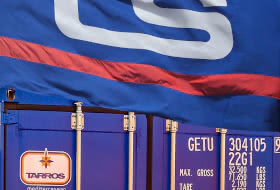
tons, and goods in containers which, with 25 thousand tons,
recorded an increase of +22.8%. However, the latter
two sectors continue to be characterized by a considerable
traffic volatility, signalling that episodic increases in
of the activity may not be an indication of a recovery
structural.
In the first nine months of 2026, the port of Taranto handled
8.99 million tonnes of goods, with a
decrease of -5.7% on the same period of last year.
Liquid bulk cargo, with 4.35 million tonnes, recorded
an increase of +31.8%, while solid ones fell by -38.2% to
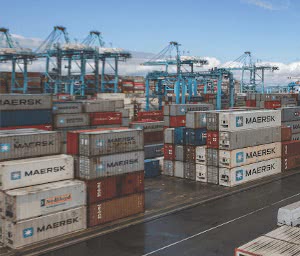
2.80 million tonnes. Conventional freight traffic is
1.59 million tonnes (-3.1%) and that of goods
containerized by 255 thousand tons (+249.4%) and was
Built with a container handling of 22,921 TEUs
(+646,1%). A bit little for a container terminal that would have a
annual capacity of two million TEUs, even if it suffers from
structural limits such as insufficiently deep seabeds.















 - Via Raffaele Paolucci 17r/19r - 16129 Genoa - ITALY


