Independent journal on economy and transport policy
02:41 GMT+2
This page has been automatically translated by Original news
SHIPPING
Spain, short sea shipping is retreating
SPC Spain warns that the costs of environmental regulations push traffic out of the sea
Madrid
October 9, 2026
Spanish short sea shipping has crossed
in the last decade a phase of expansion, followed by fluctuations
that have slowed down its growth. One of these negative variations
was recorded in the first half of this year when
These maritime transport services handled 124 million
of tons of goods, with a decrease of -6.8% on the first half
of 2025. If the overall positive trend of the decade
could lead to the first six months of 2026 being considered a new
fluctuation, however, to worry the Shortsea Promotion Centre
Spain (SPC Spain) is the comparison with road transport.
The Spanish Association for the Promotion of Shortsea Shipping,
in fact, he highlighted how the half-year figure confirms the trend
negative trend in recent years and comes together with a contraction
of the offer of alternative maritime services to the road.
Submitting its latest report on ocean freight to
SPC Spain explained that the decline in the
first half of 2026 concerns both foreign traffic (-4.7%), and
accounts for 78.2% of the total, and, more markedly,
cabotage (-13.6%), which is equal to 21.8% of the total. How much
to the type of goods, the most marked decrease was
was marked by containerized cargo (-22.8%), followed by
rolling stock (-7.5%) and dry bulk (-4.2%). Growth in
liquid bulk (+6.4%).
The report points out that, in particular, maritime transport
international short-range ro-ro, which is the main
maritime alternative to road transport, has fallen by
-1.2% to 13.3 million tonnes. On the Atlantic front, the decline was
-4.8%, while the Mediterranean remained substantially
stable (-0.7%). Trucks (about 696 thousand units, 1.6 million
of tonnes) fell by -2.7% year-on-year, although they
marked an increase of +5.1% compared to the second half of 2025.
Shipments decreased by -8.7%, while landings decreased by
grew by +11.1%.
For SPC Spain, the most worrying fact is that at the
contraction in demand is accompanied by a new cut
of supply, since the capacity of the loading services
rolling stock alternative to the road, which fell by -7.3% compared to the first
half of 2025, with a reduction on the Atlantic front of -8.8%
(from 1.3 to 1.2 million linear meters) and on the Mediterranean front
by -6.5% (from 2.7 to 2.5 million linear metres). A decrease -
noted the association - due to the adjustment of capacity
of maritime transport to the declining demand implemented by the companies
navigation. The report specifies that the signal is more
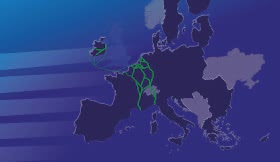
evident concerns the Motorways of the Sea which have dropped from ten to
seven lines: on the Atlantic there are two (there were three) and on the
five (there were seven). The total capacity
of the Motorways of the Sea fell by -10.2%. On the front
Atlantic the reduction was -19.9% (from 531 to 425 thousand
linear meters), on the Mediterranean market by -7.9% (from 2.2 to 2.0
million). According to the association, this phase of adjustment
risks reducing the alternatives available to operators and
limit the contribution of short sea shipping to the
decarbonisation and decongestion of roads.
The report also notes that the effect on the employment rate is
paradoxical: the reduction in supply (about -13% on an annual basis)
it brought the estimated employment to 80.0% against 68.3% in 2025.
In the Mediterranean, it rose to 86.2% (72.5% in 2025) and
on the Atlantic to 65.8% (58.9%). The improvement therefore derives from the
capacity cuts, not from a recovery in demand.
The document also draws a (heterogeneous) picture
evolution of short sea shipping traffic
compared to the European services markets. On the Atlantic front, trade
with Belgium decreased by -20.7%, with the United Kingdom by
-10.4% and with Ireland -6.0%. The only exception is the Netherlands,
up +564% thanks to the opening of the line with Vilagarcía
de Arousa, but on very small volumes. On the front
Morocco, which remains the first market in terms of volumes, has
-2.3%. Italy grew by +1.3% (but compared to
to a decline of -9.4% recorded in the first half of 2025).
The report also presents a comparison with transport
explaining that the first half of 2026 is part of
A reversal of the trend that is now consolidated. Between 2013 and 2019
Short Sea shipping has grown on average
of +7.8% per year, against +4.6% for the road, with a correlation
between the two modes of 0.95. Between 2021 and 2025, the
The situation has been reversed: shipping is short
radius lost an average of -2.3% per year, while transport
grew by +1.1%, with a negative correlation
of -0.41. The association links the change of course to the entry into
force, on January 1, 2020, of the International
Maritime Organization which lowered the upper limit of the
of sulphur in marine fuels, and, subsequently, of the
EU ETS emissions trading and the EU Regulation
FuelEU Maritime. The analysis by countries in the period 2021-2025 shows
whereas the impact is greatest in EU countries, with transport
short sea shipping of rolling stock that with Italy has gone down
-4.4% compared to +0.7% for road transport, and
with percentage changes that were respectively +2.3%
and +3.7% with Belgium, -4.4% and -7.2% with the United Kingdom and
+14.4% and +2.8% with Morocco.
The report points out that the share of short shipping
ro-ro range in international transport flows (road more
sea) fell to 10.7% in 2025 from 11.0% in 2024 and
maximum of 12.1% in 2021. The highest shares are recorded
in Italy (46.8%), the United Kingdom (28.2%) and Belgium (20.9%).
SPC Spain therefore fears that the first half of 2026 will not be
Not at all a swing, but a game-changer for transportation
in Spain. In light of this,
The association calls for the transition to more sustainable transport
sustainable transport takes into account the competitiveness of transport
and the cumulative impact of new environmental standards.
According to SPC, higher costs and regulatory restrictions are
pushing traffic towards the road, with effects opposite to the
decarbonization goals.
- Via Raffaele Paolucci 17r/19r - 16129 Genoa - ITALY
phone: +39.010.2462122, fax: +39.010.2516768, e-mail
VAT number: 03532950106
Press Reg.: nr 33/96 Genoa Court
Editor in chief: Bruno Bellio No part may be reproduced without the express permission of the publisher







 Spanish short sea shipping has crossed
in the last decade a phase of expansion, followed by fluctuations
that have slowed down its growth. One of these negative variations
was recorded in the first half of this year when
These maritime transport services handled 124 million
of tons of goods, with a decrease of -6.8% on the first half
of 2025. If the overall positive trend of the decade
could lead to the first six months of 2026 being considered a new
fluctuation, however, to worry the Shortsea Promotion Centre
Spain (SPC Spain) is the comparison with road transport.
The Spanish Association for the Promotion of Shortsea Shipping,
in fact, he highlighted how the half-year figure confirms the trend
negative trend in recent years and comes together with a contraction
of the offer of alternative maritime services to the road.
Spanish short sea shipping has crossed
in the last decade a phase of expansion, followed by fluctuations
that have slowed down its growth. One of these negative variations
was recorded in the first half of this year when
These maritime transport services handled 124 million
of tons of goods, with a decrease of -6.8% on the first half
of 2025. If the overall positive trend of the decade
could lead to the first six months of 2026 being considered a new
fluctuation, however, to worry the Shortsea Promotion Centre
Spain (SPC Spain) is the comparison with road transport.
The Spanish Association for the Promotion of Shortsea Shipping,
in fact, he highlighted how the half-year figure confirms the trend
negative trend in recent years and comes together with a contraction
of the offer of alternative maritime services to the road.













 - Via Raffaele Paolucci 17r/19r - 16129 Genoa - ITALY


