Independent journal on economy and transport policy
19:09 GMT+1
This page has been automatically translated by Original news
SHIPPING
Suez Canal, signs of resumption of naval transit in September
However, the repercussions of the crisis in the Red Sea persist
Ismailia
November 3, 2026
The Suez Canal continues to deal with deep
geopolitical and economic readjustments linked to instability
of the Middle East, although the latest data recorded during the
2026 show a gradual and prudent return of trade
along the historic maritime route. Traffic data
in fact, show a progressive rise compared to the collapses
reached between 2024 and 2025, while remaining far from the
glories of the pre-crisis period.
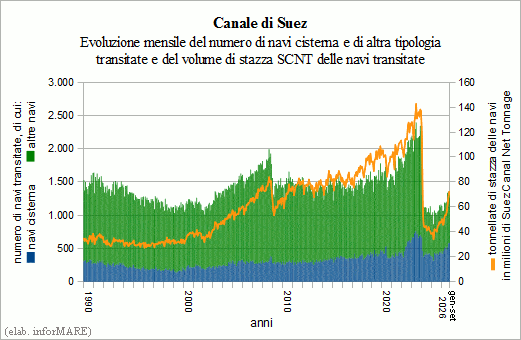
In September of this year, the canal
a total of 1,352 ships, with an increase of +17.4% on the
September 2025, of which 582 tankers (+29.0%) and 770 other units
(+9.8%), for a total SCNT net tonnage of €72.5 million
of tons (+51.0%).
Between July and September 2026, the Egyptian channel recorded a
total of 4,050 ship transits, up +23.6% on the third
quarter of last year, of which 1,688 oil tankers (+30.5%) and
2,362 other ships (+19.1%), reaching a total net tonnage
of 203.8 million tons (+47.5%).
In the first nine months of 2026, total maritime traffic was
10,954 transits, up +17.4% on the same
period of 2025, of which 4,602 oil tankers (+25.7%) and 6,352
other type (+12.0%).
If the third quarter of this year showed
the most significant acceleration of the year, driven by the
cautious return of some major shipping companies on the routes
of Suez, however, the volume of transits continues to be far away
from that of the pre-crisis period, before the geopolitical crisis
radically changed global shipping routes. In the third
quarter of 2023, for example, there were 6,523 ships transited
against 4,050 in the same period of 2026. Despite the signs
and the increase recorded at the beginning of the current
autumn, the overall volumes of maritime traffic therefore travel
still at a level about 35-40% lower than the
historical parameters prior to the blockades of ship traffic in the Sea
Started from the end of 2023. Following the
conflict that broke out in the Middle East at the end of 2023, in fact, the
Yemeni Houthi movement has launched a systematic campaign of
attacks with drones, missiles and armed teams against ships in
transit through the Red Sea and the Bab el-Mandeb Strait, with new
waves of tension also recorded at the end of the summer of 2026.
The crisis in the Red Sea is not an isolated event, but it is
part of the broader strategic and geopolitical confrontation
pitting Iran, its regional allies (including the
Houthis) and the US-led coalition. This context of
hybrid warfare has made the entire area a highly
volatile, fueling the risks of escalation also in the Strait of
Hormuz and altering global oil, gas and energy flows. To
avoid ballistic risks and prohibitive insurance costs
against the risks of war, the vast majority of companies
has chosen, and in part continues to prefer
albeit with gradual returns, the alternative route circumnavigating
Africa around the Cape of Good Hope. This, of course,
involves extended travel times of 10-15 days and has a
significant impact on maritime freight rates.
Data for September and the third quarter of 2026 confirm
that the Suez Canal is not "closed" and remains
fully operational from an infrastructural point of view, showing
encouraging signs of recovery. However, the return to flooding
normality will depend entirely on stability
of security in the Red Sea and in the Bab el-Mandeb region.
- Via Raffaele Paolucci 17r/19r - 16129 Genoa - ITALY
phone: +39.010.2462122, fax: +39.010.2516768, e-mail
VAT number: 03532950106
Press Reg.: nr 33/96 Genoa Court
Editor in chief: Bruno Bellio No part may be reproduced without the express permission of the publisher







 The Suez Canal continues to deal with deep
geopolitical and economic readjustments linked to instability
of the Middle East, although the latest data recorded during the
2026 show a gradual and prudent return of trade
along the historic maritime route. Traffic data
in fact, show a progressive rise compared to the collapses
reached between 2024 and 2025, while remaining far from the
glories of the pre-crisis period.














 - Via Raffaele Paolucci 17r/19r - 16129 Genoa - ITALY


