
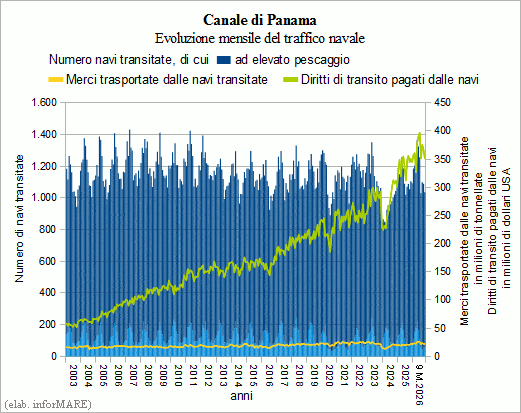
Between July and September in the Panama Canal 3.225 ships have passed, with a rise of +0.4% on the same period of 2025. In the face of the stability of the marine traffic, however, the tonnage of the ships transited, according to the system of measurement of the channel Central American, is increased of +4.4% being piled to 131,0 million tons PC/UMS, while the volume of the goods that have crossed the way of water has marked an increase even more marked of +9.0% going up to 68,3 million tons. The data therefore evidence an increase of the ability to transport averagely transited through the entireceanic way, with an increment of the enlivened volumes greater than that of the number of ships.
The fiscal year 2026, concluded on 30 September last, has totaled 13.951 transits of ships, in increase of +4.1% regarding the 13.404 of the exercise precedence. The Authority of the Panama Canal has emphasized that the recovery has been supported above all by the energy segments and the portacontainer. A significant contribution came from the ships using the new Neopanamax locks, responsible for 52.2% of the total tonnage of the fiscal year, with an increase of +8.2% regarding the exercise precedence. According to the administration of the channel, the results were also favored by the possibility to maintain a maximum fishing of 50 feet throughout the dry season, guaranteeing operating conditions favourable to the users of the route.
The analysis of the composition of the naval traffic in the third trimester of 2026 shows an uneven evolution between the different categories of ships. The portacontainer and other ships of greater tonnage, considered altogether, have totaled 3.063 transits (+1.6%). Within this category, however, there is a different dynamic between the two types of locks. The Neopanamax ships have made 879 transits, with a decrease of -3,3% regarding 909 of the same period of 2025. The transits of the Panamax ships are increased from 2.304 to 2.346 (+1.8%).
The Authority of the Canal has announced that the recent rainy precipitations, found close to the average values in the area of the hydrographic basin, together with the effectiveness of the measures of water saving adopted, have allowed to restore the reservation service of the last minute for the ships that use the Panamax locks. The service allows ships without reservation to get a transit when making a slot available, based on the discretion of the Authority.















 - Via Raffaele Paolucci 17r/19r - 16129 Genoa - ITALY


