Independent journal on economy and transport policy
15:30 GMT+1
This page has been automatically translated by Original news
SHIPPING
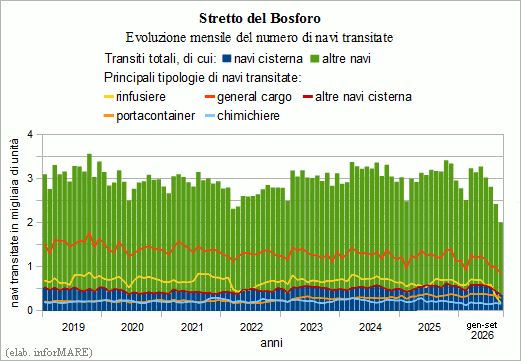
Bosphorus Strait, ship transits plummeted by -23.2%
In the third quarter, bulk carrier passages halved. The decline in the Dardanelles was more contained (-12.8%), while container ships held up
Ankara
November 11, 2026
The recent multiplication of attacks on ships in the region
of the Black Sea, in the context of the war between Russia and Ukraine,
in a context of strong contraction in maritime traffic
in the Bosphorus Strait, which in the third quarter of 2026
recorded a decrease of -23.2% compared to the same period
last year. In fact, only 7,934 ships passed through compared to
to 10,329 in the July-September quarter of 2025.
The transits of most of the
main categories of ships transiting the Turkish Strait,
starting with general cargo ships which totaled 2,789
transits (-23.7%), from other types of tankers with 1,289
transits (-19.9%) and bulk carriers with 1,057 transits (-47.3%).
On the other hand, container ship traffic is stable with 952 transits
(-1,1%).
In the third quarter of this year, ship traffic in the
Dardanelles Strait, on the other hand, has contracted
less marked as 9,952 ships passed through it (-12.8%)
The difference between the contractions of ship transits in the two
Turkish straits is therefore significant. The Bosphorus, which
is the main maritime passage between the Black Sea and the
Sea of Marmara, records a decrease almost double compared to the
Dardanelles, which connect the Sea of Marmara to the Aegean Sea. The different
intensity of contraction can be reduced,
at least in part, to the greater exposure of direct traffic
towards the ports of the Black Sea to the effects of the war. The attacks
against merchant ships, the risks to navigation,
disruptions to port activities and uncertainty about
security conditions may have led some vessel operators
to reduce or modify their programs. Added to this are the
possible changes in trade flows of cereals,
petroleum and other commodities.
Considering the main categories of commercial vessels, the
The most evident collapse is that of the transits of
bulk carriers, which have practically halved in both
Narrow. This is a particularly significant contraction,
whereas the role of the Black Sea in the international trade of
grains, coal, minerals and other bulk products. Ships for
general goods have recorded a significant decrease,
especially in the Bosphorus. As far as oil tankers are concerned, even
This type of ship has been particularly affected
by the events of the war, with attacks that in recent months have
interested tankers engaged in the transport of crude oil and products
oil tanks, in particular in the vicinity of Novorossiysk and the
offshore terminal of the Caspian Pipeline Consortium. A marked
The difference was marked by the contraction of transits of
chemical tankers, more evident in the Bosphorus (-27.5%) than in the
Dardanelles (-11.7%).
A separate chapter seems to be that of container ships, which
show a decidedly different trend from that of ships
for bulk cargo. Being substantially stable in both
Narrow, with a slight increase at the Dardanelles (+1.4%), traffic
of this type of vessel suggests a greater capacity
of regular services with respect to bulk transport. The
statistical tightness does not mean, however, that container carriers
remained immune to attacks. The sinking of the
container ship Contship Jet took place last month, after
having been hit by naval drones in the exclusive economic zone
confirms that ships in this category are also on display
to significant risks.
Another category of ships that shows a very low contraction
accentuated is that of ro-ro, which was
particularly consistent in the Bosphorus where transits have
reduced by more than half (-51.5% compared to -23.8% in the
Dardanelles).
In clear contrast to the trend are the transits of car carriers, which are
increased significantly in both the Bosphorus (+56.0%) and the Dardanelles
(+49.1%), confirming an uneven trend in the various
components of maritime traffic.
- Via Raffaele Paolucci 17r/19r - 16129 Genoa - ITALY
phone: +39.010.2462122, fax: +39.010.2516768, e-mail
VAT number: 03532950106
Press Reg.: nr 33/96 Genoa Court
Editor in chief: Bruno Bellio No part may be reproduced without the express permission of the publisher







 The recent multiplication of attacks on ships in the region
of the Black Sea, in the context of the war between Russia and Ukraine,
in a context of strong contraction in maritime traffic
in the Bosphorus Strait, which in the third quarter of 2026
recorded a decrease of -23.2% compared to the same period
last year. In fact, only 7,934 ships passed through compared to
to 10,329 in the July-September quarter of 2025.













 - Via Raffaele Paolucci 17r/19r - 16129 Genoa - ITALY


