Independent journal on economy and transport policy
18:33 GMT+2
This page has been automatically translated by Original news
SHIPPING
Green maritime corridors, China leads the race
Almost a fifth of the world's initiatives involve a Chinese port. The Global Maritime Forum report points to fuel and collaboration as strengths, while demand remains weak
Shanghai
October 22, 2026
In the space of four years, China has gone from being a supporting actor
a reference point for green maritime corridors and today almost a
fifth of the world's initiatives involve a Chinese port. The
notes the new report "Green shipping corridors: How China
is re-energising the global movement" of the Global Maritime
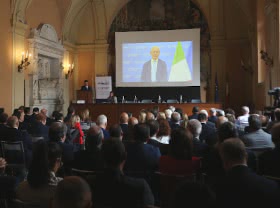
Forum that was presented yesterday in Shanghai, during the
Global Maritime Forum Annual Summit 2026.
Specifying that the green corridors are maritime routes on which the
feasibility of zero-emission navigation is
supported by joint action by the public and private sectors, the report
explains that in June 2026 at least 21 maritime corridor initiatives
The green elections announced involved China. In 2022, when the Forum
had begun to measure the phenomenon, there were only three. 2025
It was the year of the turning point, with the presentation of ten
new initiatives and the launch, by the Ministry of Transport
of Beijing, the "Initiative for International Cooperation on
Green Shipping Corridors".
More than half
of the corridors linked to China involves partners from the European Union.
European ports also include three Spanish ports: Barcelona
(in partnership with Shanghai), Valencia and Algeciras (both with
Ningbo-Zhoushan).
In particular, of the 21 initiatives involve China - of which
12 at the start, five in exploration, three in preparation and one in
construction phase - 16 concern corridors between ports, with the
Shanghai Chinese Port connected with the ports of Hamburg, Los Angeles,
Angeles, Long Beach, Melbourne, Antwerp-Bruges and Barcelona, with the
Ningbo-Zhoushan China port connected with Hamburg,
Wilhelmshaven, Valencia, Le Havre, , Algeciras, Abu Dhabi and
Felixstowe, with the port of Qingdao connected with Hamburg and
Wilhelmshaven, with the Tianjin County connected with Singapore and with
the port of Guangzhou connected with Los Angeles.
Another initiative concerns a corridor between the province of
Shandong with Singapore and four others are multiport corridors
(Australia-East Asia; Singapore; Silk Alliance and Portugal).
About the seven initiatives that have already chosen the
ship segment, three involve the use of container ships, two of which involve the use of
ro-ro vessels, one bulk carrier and one container ship more
ro-ro. With regard to the naval fuel to be used, for six
initiatives the chosen fuel type and the two
methanol and ammonia are more suitable.
The report indicates precisely fuels and technologies such as
major strength of China and highlights that projects in
development in China target up to 30 million tons of methanol
and 15 million green ammonia by the early thirties.
These quantities are equal to more than 60% of the
global green methanol projects and about 15% of those of
green ammonia. The report specifies that 80% of the capacity
of green methanol already beyond the final decision of
investment and more than 40% of those ammonia is located in China,
and there green ammonia costs up to 20-30% less than in
competing regions. It also points out that bunkering of
methanol has gone from less than 540 tons in 2024 to
64,000 in 2025 and 100,000 in mid-2026, 90%
carried out in Shanghai. China is also a major contributor to electric batteries
next: the Greenwater 700 TEU container ship of the
COSCO, which entered service in 2024, exceeds 50 MWh of
capacity, against 1 MWh of the Norwegian ferry MF Ampere
with a capacity of 360 passengers and 120 vehicles dating back to
ten years ago.
The document also points to the propensity of Chinese partners to
closing long-term supply agreements, still rare in the rest
of the world. Examples include the agreements between Maersk and LONGi, Hapag-Lloyd
and Goldwind, CMA CGM and Shanghai Electric. Also the models of
risk sharing are innovative: CMB. TECH, for example,
In addition to signing a contract for the supply of ammonia, it has invested in
directly in the Chinese company of the supply chain.
The Global Maritime Forum report also focuses on the
rapid strengthening of Chinese policies in this area, with
green hydrogen, which, for example, has entered the
of the 15th Five-Year Plan. In addition, in February 2026
a plan has been launched to make Shanghai a hub
international green bunkering by 2030, with the aim of
of one million tons per year of methanol and biofuels.
The document also highlights several critical elements,
starting with demand. As elsewhere, in China too the owners
of cargoes are not willing to pay enough for transport to
zero emissions to absorb the potential supply. A survey
warns that 65% of global shippers would accept a
surcharge, on average about +3%. In addition, the cost gap
between traditional and sustainable marine fuels remains wide: even to the
Chinese prices, green methanol and ammonia cost two to three times
conventional fuels.
Other obstacles are the
certification of fuels according to global standards, the
bunkering and charging infrastructure and possible competition
of the domestic industry for green ammonia. In addition, the document
notes that there is a regulatory limitation on the corridors with Europe:
on non-EU maritime routes, the EU ETS and the
European FuelEU Maritime regulation only applies to 50%
of the energy consumed, so additional support would be needed.
To address these critical issues, the report formulates
four recommendations: upgrading methanol infrastructure,
ammonia and electric ships, with certification standards
compatible with international ones; apply the best
international governance practices and enhancing partnerships
existing ones; use policy tools to close the cost gap
fuels; stimulate demand, focusing on the sectors
pioneers and aggregating buyers.
According to the report,
China's green maritime corridors could open up access to a
bunkering market worth $100 billion and ad
global investments of 1-2 trillion, with the creation of up to
four million green jobs. In its budget, the
Global Maritime Forum calls them an advantageous opportunity
for China and for the rest of the world.
- Via Raffaele Paolucci 17r/19r - 16129 Genoa - ITALY
phone: +39.010.2462122, fax: +39.010.2516768, e-mail
VAT number: 03532950106
Press Reg.: nr 33/96 Genoa Court
Editor in chief: Bruno Bellio No part may be reproduced without the express permission of the publisher







 In the space of four years, China has gone from being a supporting actor
a reference point for green maritime corridors and today almost a
fifth of the world's initiatives involve a Chinese port. The
notes the new report "Green shipping corridors: How China
is re-energising the global movement" of the Global Maritime
Forum that was presented yesterday in Shanghai, during the
Global Maritime Forum Annual Summit 2026.









 - Via Raffaele Paolucci 17r/19r - 16129 Genoa - ITALY


