Independent journal on economy and transport policy
21:31 GMT+2
This page has been automatically translated by Original news
PORTS
The Port of Singapore sets a new all-time record for quarterly container traffic (in TEUs)
Ship fuel sales highlight the ongoing transformation of the fuel market
Singapore
October 14, 2026
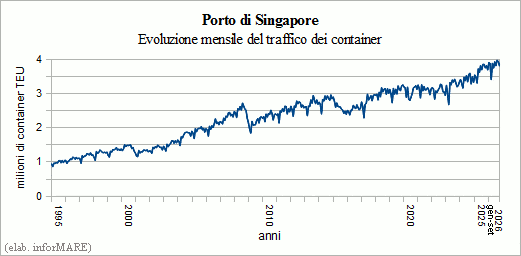
In the third quarter of 2026, the Port of Singapore
154.6 million tons of goods handled, with a decrease of
-2.7% on the same period last year which was
determined by the reduction in the volume of oil bulk,
down by -13.3% to 43.1 million tons. Traffic alone
containerized, amounting to 93.4 million tons, remained
stable (+0.3%) if measured by weight, while if measured by volume it has
marked an increase of +2.4% and a new all-time high
quarterly balance having amounted to 11.8 million containers to be
twenty feet. In the period July-September of this year, the traffic
of conventional cargo and non-oil bulk cargo recorded
the new record for this quarter having stood
respectively to 8.6 million (+6.7%) and 9.6 million tons
(+17,1%).
With regard to bunker supplies, of which Singapore is
the world's leading port, the dispensing of naval fuel in the
ports of call are growing and highlight the
transformation of the marine fuel market produced by the
new international standards for the decarbonisation of shipping,
with expanding liquefied natural gas and marine diesel
traditional in strong downsizing.
In the third quarter of this year, sales of
bunkers totaled over 14.2 million tons, in
decrease of -2.8% year-on-year but with significant changes
in the composition of the products supplied to ships. The comparison with
However, 2023 shows an increase of +9.2% in bunkers sold to
Singapore: Over a three-year period, quarterly sales were
increased by about 1.2 million tons and the 2026 level
therefore remains high, even if lower than the peak of the year
previous. In addition, the dynamics of the third quarter of 2026 go
read together with that of the first nine months of the year: between January and
September volumes reached about 42.5 million tons,
with an increase on an annual basis of +2.1%. The decline of the third
has therefore not cancelled out the growth accumulated in the
first part of the year.
On the evolution of sales of the different types of fuel
ships, the data show the downsizing of distillates
with the clearest figure concerning Marine Gas
Oil: in the third quarter of 2023, MGO sales amounted to
about 50,700 tons; in the quarter of 2026 they fell to about
1,800 tons. For low-sulphur marine diesel
(LSMGO), the data show much higher volumes
substantial: about 827,000 tons in the third quarter of 2023,
929,000 in 2024, 1.16 million in 2025 and 1.11 million in 2026.
After the strong expansion in 2025, the product recorded a
a decrease of -4.6% in the third quarter of this year.
Among fuel oils (MFO, LSFO and ULSFO), the
low sulphur component and overall continue to
be an important part of supplies. Natural gas
liquefied is one of the fastest growing segments
evident: in the third quarter of 2023, LNG sales amounted to
to about 41,500 tons; in 2024 they had risen to 125,700
tons, in 2025 to 156,900 and in 2026 they have reached about
168,800 tons. The growth compared to 2025 is +7.6%,
while compared to 2023, volumes have more than quadrupled.
The increase testifies to the progressive consolidation of LNG among the
fuels available for maritime transport, while remaining
its quantitative weight is significantly lower than that of oils
traditional fuels. Finally, in Singapore, the supply of
methanol and biofuels are still marginal.
- Via Raffaele Paolucci 17r/19r - 16129 Genoa - ITALY
phone: +39.010.2462122, fax: +39.010.2516768, e-mail
VAT number: 03532950106
Press Reg.: nr 33/96 Genoa Court
Editor in chief: Bruno Bellio No part may be reproduced without the express permission of the publisher







 In the third quarter of 2026, the Port of Singapore
154.6 million tons of goods handled, with a decrease of
-2.7% on the same period last year which was
determined by the reduction in the volume of oil bulk,
down by -13.3% to 43.1 million tons. Traffic alone
containerized, amounting to 93.4 million tons, remained
stable (+0.3%) if measured by weight, while if measured by volume it has
marked an increase of +2.4% and a new all-time high
quarterly balance having amounted to 11.8 million containers to be
twenty feet. In the period July-September of this year, the traffic
of conventional cargo and non-oil bulk cargo recorded
the new record for this quarter having stood
respectively to 8.6 million (+6.7%) and 9.6 million tons
(+17,1%).
In the third quarter of 2026, the Port of Singapore
154.6 million tons of goods handled, with a decrease of
-2.7% on the same period last year which was
determined by the reduction in the volume of oil bulk,
down by -13.3% to 43.1 million tons. Traffic alone
containerized, amounting to 93.4 million tons, remained
stable (+0.3%) if measured by weight, while if measured by volume it has
marked an increase of +2.4% and a new all-time high
quarterly balance having amounted to 11.8 million containers to be
twenty feet. In the period July-September of this year, the traffic
of conventional cargo and non-oil bulk cargo recorded
the new record for this quarter having stood
respectively to 8.6 million (+6.7%) and 9.6 million tons
(+17,1%).














 - Via Raffaele Paolucci 17r/19r - 16129 Genoa - ITALY


