Independent journal on economy and transport policy
23:30 GMT+2
CEREMONIES
World trade more resilient than expected. AI pushes goods, services slows down
The WTO revises its estimates: goods at +3.9% in 2026, services at +3.3%. But the impact of the crisis in the Middle East is not the same for everyone
Ginevra
October 8, 2026
World trade held up better than expected
in the first half of 2026, despite the shock caused by the
conflict in the Middle East, with supply chains
have adapted and with the boom in investments in intelligence
which has given a strong boost to trade in goods. The
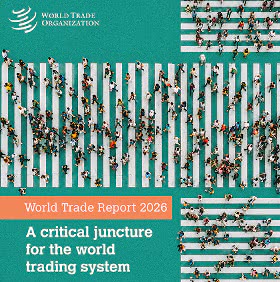
underlines the latest "Global Trade Outlook and Statistics"
published today by the World Trade Organization, which specifies that
Not everything, however, held up in the same way: the services and
Some regions have been more affected by the crisis.
The document explains that in the first six months of 2026 the volume
of trade in goods grew by 3.5%, more than
expected. Two factors contributed to the increase. The
first is the adaptation of energy supplies and
fertilizers. According to WTO estimates, exports of
crude oil from the Middle East recorded a-24% and those
of liquefied natural gas -47%. But the increase in shipments of
other suppliers limited the global decline to around -6% for the
crude oil and only -1% for LNG. The market also on fertilizers
it has rebalanced. Then there was the boom
artificial intelligence, with the demand for "enabling" goods
AI, such as semiconductors and servers, which accounts for 47% of the growth
in world trade in goods in the first half of the year.
Trade in these products rose by +67% year-on-year,
after +16% in 2024 and +31% in 2025. The report specifies that
It is about values and not volumes: measured growth reflects
hence in part the increase in prices and capacities
product techniques. The estimates of the European Central Bank cited
from the WTO indicate increases in the import prices of these
goods around +10% in 2025 and +20/+30% in the first half of 2025
this year.
As for world trade in services, the document discloses
which grew by +14% year-on-year in value in the first
quarter and +10% in the second. It was slowed down by transport and
tourism, sectors closely linked to the role of hub played by the Middle East
East. In particular, in transport, the reorganization of the
routes and the surge in freight rates have inflated the values much more
of volumes. At the end of June, spot container freight rates from Asia were
around $6,200-8,000 per feu to North America and
4,900-6,500 to Europe and the Mediterranean. Traffic in China
grew by +5.9% in the first half of the year, while the
exports and imports of transport services rose by
+31% and +36%. In the Persian Gulf, traffic has shifted:
the Emirati port of Jebel Ali lost about -60% in the half-year
(-90% in the second quarter), while Sohar (+40%) and
Salalah (+15%) in Oman and the southern container terminal in Jeddah, in
Saudi Arabia (+79%).
On the uneven impact of the crisis on the
different regions of the world, the WTO report explains that,
with regard to trade in goods by volume, in the whole of 2026
Asia is expected to see the most dynamic exports
(+9.9%), ahead of North America (+5.7%), Africa (+5.6%) and South
America (+3.4%). This is compared to a Europe that is substantially
(-0.1%) and a decline for the Community of States
Self-employed (-3.9%) and especially for the Middle East (-17.2%).
On the import front, Asia grew the most (+9.5%),
Africa (+8.9%) and CIS (+8.8%), while North America (+1.4%) and Europe
(+0.5%) advanced little and the Middle East collapsed (-15.4%). The
However, the document points out that North American imports, in particular
Down by -3.2% in the half-year, mainly due to early purchases
before the US tariffs of 2025, they recovered in the second
quarter (+5.3% y/y). This suggests a demand
stronger underlying than the estimate of +1.4% for
per year.
In services, Europe is expected to grow more than
all in exports (+4.6%), ahead of Asia (+4.0%) and Africa
(+3,1%). North America and CIS (+1.7% both) and South are weaker
and Central America (+1.3%), while the Middle East is expected to
decrease of -10.3%. Europe is expected to generate more than half
growth in global services exports, offsetting the lower
contribution from Asia, North America and the Middle East.
The report then devotes an analytical chapter to the exchange of goods
enabling artificial intelligence. If until 2023 they were moving
in line with the rest of the goods trade, from 2024 they have
accelerated, bringing their share of world trade in goods
from 7-8% in the period 2016-2023 to 14.8% in the first half of 2026. Yes
This is a very concentrated phenomenon. In 2025, the ten largest
operators accounted for about 85% of exports and 80%
of imports. On the one hand, supply: East Asia excluded
China is worth 40.4% of the export of these goods (compared to 10.8% of the
the total of goods) and Southeast Asia 23.2%. On the other hand,
Question: The United States, China and Hong Kong together absorb about
half of imports, with the American share growing and the
declining. In the second quarter of 2026, North America
contributed 18.5 percentage points to the growth of +70%
of imports. Europe is marginal: it accounts for 35.5%
of total exports of goods but only 10.6% of that of goods
enabling AI, despite hosting ASML, the only provider of
Extreme ultraviolet lithographs for microchip production.
Among European economies, only the Netherlands is among the ten largest
operators. For the WTO, economies with a limited presence in the
value chain, while growing, is not recovering for now
with a few exceptions.
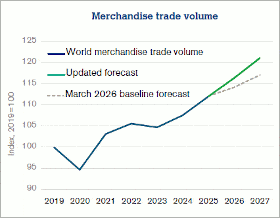
The report also presents the new forecasts for the entire
2026 and for the following year. For 2026, WTO economists
have raised the forecast of growth in trade volume
of goods at +3.9%, compared to +1.9% indicated in the base scenario of
March. For 2027, the estimate rises to +4.1% (it was +2.6%). Trade
of commercial services, on the other hand, follows the opposite direction: +3.3% in the
2026, down from +4.8% forecast in March, with a rebound to the
+6.4% in 2027. Combining the two components, the volume of trade
of goods and services is expected to grow by about +3.7% in 2014.
2026 and +4.7% in 2027, against a gross domestic product
increase by +2.6% and +2.9%. Trade - specification
The report - exceeds economic growth also because the
AI-related investments are richer in imports than
to other items of expenditure.
The document highlights that the forecasts remain exposed to
significant risks. The first is the distance between the price of the
crude oil and refined products, which erodes purchasing power
of households. The report estimates that, compared to a shock to the
crude oil alone, this gap subtracts from the growth of the
imports 0.22 percentage points in Asia, 0.14 in North America and
0.06 in Europe. Brent, after peaking at $138 on April 8th, is
back to around $100 and gas in Europe has exceeded $21
dollars per MMBtu, the highest level since 2022. The second is
a slowdown or reversal of investment in AI, which
would have a strong impact on trade due to the high content of
import. The report also recalls the wealth effect: AI weighs heavily
More and more on the capitalization of the stock market
and a possible revaluation would affect families
exposure through index funds. In addition,
Inflation: forecasts for 2026 have been revised from +3.7%
to +4.7%, while estimates for 2027 also depend on a
timely resolution of the conflict in the Middle East.
- Via Raffaele Paolucci 17r/19r - 16129 Genoa - ITALY
phone: +39.010.2462122, fax: +39.010.2516768, e-mail
VAT number: 03532950106
Press Reg.: nr 33/96 Genoa Court
Editor in chief: Bruno Bellio No part may be reproduced without the express permission of the publisher






 World trade held up better than expected
in the first half of 2026, despite the shock caused by the
conflict in the Middle East, with supply chains
have adapted and with the boom in investments in intelligence
which has given a strong boost to trade in goods. The
underlines the latest "Global Trade Outlook and Statistics"
published today by the World Trade Organization, which specifies that
Not everything, however, held up in the same way: the services and
Some regions have been more affected by the crisis.
World trade held up better than expected
in the first half of 2026, despite the shock caused by the
conflict in the Middle East, with supply chains
have adapted and with the boom in investments in intelligence
which has given a strong boost to trade in goods. The
underlines the latest "Global Trade Outlook and Statistics"
published today by the World Trade Organization, which specifies that
Not everything, however, held up in the same way: the services and
Some regions have been more affected by the crisis.












 - Via Raffaele Paolucci 17r/19r - 16129 Genoa - ITALY


