Independent journal on economy and transport policy
12:22 GMT+2
This page has been automatically translated by Original news
SHIPPING
ETS maritime, Brussels opens up to hybrid and electric ferries, but Interferry asks for more
The proposed revision strengthens the SMAP mechanism but leaves AFIR and FuelEU Maritime the game of port networks and infrastructures
Bruxelles
September 24, 2026
Interferry, the international association representing
ferry companies, took her time, maybe even
too much given the impact that the regulatory proposal may have
on the activity of the European associates, to comment on the
proposal for the revision of the Emissions Trading System
(EU ETS) presented by the European Commission last July
(
of 17
July 2026).
Today, Interverry has expressed its support for the proposal
believing that 'it has significant potential to accelerate the
maritime decarbonisation, provided that the final text
ensures accessible shore-side power infrastructure, and
reliable grid connections, through obligations for Member States
and more robust funding mechanisms'. The
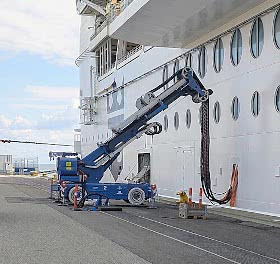
reference is to the availability in ports of plants
of onshore power supply (cold ironing) that allow ships to
connect to the shore power supply by turning off the auxiliary motors
on board.
The association, in fact, highlighted that "the expansion of the
of hybrid and battery-electric ferry operations
depends on EU passenger ports' compliance with the
legal obligations relating to the supply of energy from shore. The
Member States must also ensure that local networks are in a
able to provide sufficient electricity for the
ports can recharge hybrid and electric ships without
compromising regional energy supplies".
In addition, Interferry has called for that in order to support the transition
energy in the maritime sector, legislators should decide to
allocate 100% of the revenues generated by the ETS applied to the
maritime sector to decarbonise the sector, by encouraging
the production of sustainable marine fuels in the EU, the
development of clean technologies and the construction of infrastructures
of ground charging. This request is not met by
what is currently provided for in the proposal for the revision of the
Commission introducing a general constraint of at least 50% of the
total ETS revenues (not specifically maritime) towards a
Broad list of priority areas - clean energy,
industrial decarbonization, maritime and air transport, management
waste, etc. - leaving the choice to Member States as to how
allocate this 50% among the different priorities.
Finally, the association of ferry companies, specifying
its support for the mechanism proposed by the Commission to
Sustainable Alternative Marine Propulsion (SMAP),
highlighted the existence of the concrete risk that the demand
exceeds the available funds. Interferry specified that the amount
estimated at one billion euros per year must in fact cover
the entire maritime sector, including ferry transport, and
noted that Member States should therefore integrate the
SMAP funding with targeted national support measures. The
fear expressed by Interferry is confirmed by the text of
revision, which states that "if for a given year the
demand is higher than availability, the
quantity of allowances shall be reduced uniformly for all
shipping companies involved in the assignment for
the year in question", thus confirming that there is no
guarantee of full coverage of demand. The proposal allows yes
that the SMAP assignment can "take into account any
support under other schemes at national, Union or
which opens the door to support schemes
national complementary, but does not impose or encourage
Member States explicitly to set up national support
targeted, as requested by Interferry.
For the association, the review must also define a path
clear and predictable so that zero-emission operators
early access to SMAP funds since, although
operators of fully electric ferries are not required to
surrender emission allowances, they still have to bear large
initial investment costs.
In the light of Interferry's comments, it appears
It is difficult to understand what aspects of the proposal to revise the
European Commission meet with the approval of the association. If the
proposed revision substantially strengthens the
ETS funding for maritime decarbonisation and recognises
explicitly ship electrification as an eligible area,
however, on the four more specific points raised by
Interferry - state obligations on OPS/network, 100% ring-fencing
maritime revenues, national financing guarantee
complementary to the SMAP, and early access to funds for operators with
zero emissions - the text does not introduce binding provisions,
leaving these aspects to different instruments (AFIR, FuelEU
Maritime), with which an explicit
coordination, or the discretion of the Member States.
- Via Raffaele Paolucci 17r/19r - 16129 Genoa - ITALY
phone: +39.010.2462122, fax: +39.010.2516768, e-mail
VAT number: 03532950106
Press Reg.: nr 33/96 Genoa Court
Editor in chief: Bruno Bellio No part may be reproduced without the express permission of the publisher







 Interferry, the international association representing
ferry companies, took her time, maybe even
too much given the impact that the regulatory proposal may have
on the activity of the European associates, to comment on the
proposal for the revision of the Emissions Trading System
(EU ETS) presented by the European Commission last July
Interferry, the international association representing
ferry companies, took her time, maybe even
too much given the impact that the regulatory proposal may have
on the activity of the European associates, to comment on the
proposal for the revision of the Emissions Trading System
(EU ETS) presented by the European Commission last July
 (
(










 - Via Raffaele Paolucci 17r/19r - 16129 Genoa - ITALY


