
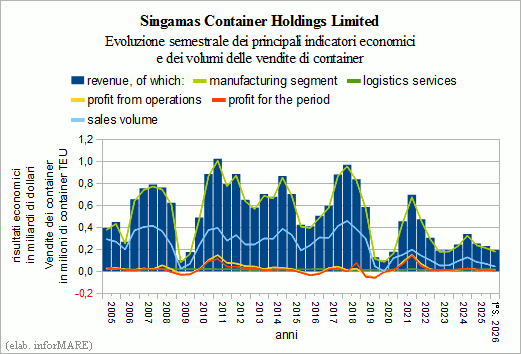
After the -46% drop recorded in the second half of 2026,
also in the following six months, sales of containers produced by the
Chinese Singamas have decreased significantly, having been equal to
43 thousand TEUs, with a decrease of -49% on the first half of 2025.
The average selling price of containers that
in the period January-June of this year it was 1,613
dollars/TEU (-12.6%).
In the first half of 2026, the Chinese company recorded
revenues of $193.8 million (-23.0%), of which $178.3 million
million generated by the production and rental activities of
containers (-24.5%) - including 60.9 million in the
dry cargo containers (-55.0%), 1.8 million in the segment
container tankers (-82.7%) and 104.5 million in the
special containers and spare parts (+29.9%) - and 15.5
million dollars from logistics services operated by the group (+0.9%).
Operating profit amounted to €7.1 million (-51.6%), with a
contribution of €4.9 million from the production and rental of containers
(-58.8%) and €2.2 million from logistics services (-21.9%). Net profit
amounted to almost $7.1 million (-52.8%).
Announcing the results achieved in the first half of 2026,
Singamas highlighted that, thanks to the transformation efforts of
of the business, the share of turnover generated by standard containers
fell to 36.4%, while specialised containers and
customized products reached 63.6% of segment turnover,
against 59.8% and 40.2% respectively in 2025. In addition,
The company specified that if container sales
grew by +17.0%, rising to
$106.3 million, more than 76.1% of that amount is
attributable to the sale of containers for storage systems
energy.
Commenting on the situation of the main market in which it operates
the company, Singamas confirmed that the global industry of
standard ISO containers continue to suffer from overcapacity
structural production that keeps prices under pressure and
penalises profitability. On the contrary, the demand for
containers for energy storage systems remains supported, pushed
global acceleration in investments in solar and
energy storage and promoted by national policies to
support for the development of green and renewable energy. Singamas
underlined that this scenario confirms the goodness of the
strategy of repositioning the Chinese group towards high-quality products
greater added value and towards a more
based on leasing and logistics activities, in the
attempt to mitigate cyclicality and pressure
that continue to characterize the container market
standard.



















 - Via Raffaele Paolucci 17r/19r - 16129 Genoa - ITALY


