Independent journal on economy and transport policy
06:28 GMT+2
TRADE
WTO, a reform of the trading system could increase world GDP by 3% by 2050
The World Trade Report 2026 warns of the costs of fragmentation: up to 7% less of world GDP in the scenario of a world dominated by free trade agreements
Ginevra
September 15, 2026
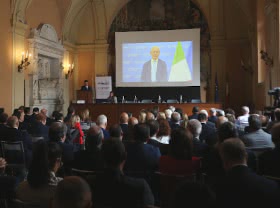
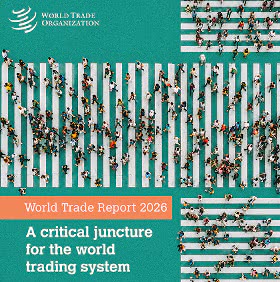
"The multilateral trading system has generated enormous
benefits over the past 80 years, helping to create an economy
more integrated and resilient global economy. The data show that
about 72% of world trade in goods still takes place according to
the terms of the most-favoured-nation clause of the
WTO, while trade cooperation promoted by the
has supported economic growth, helped to reduce the
between developing and advanced economies, and
fostered peace among the members". This was underlined by the
Director General of the World Trade Organization, Ngozi
Okonjo-Iweala, presenting the "World Trade Report 2026",
the WTO's flagship report that was published today and
is titled "A Critical Juncture for the World Trading
System".
Referring to the crucial moment evoked by the title of the report,
Okonjo-Iweala noted that "the trade landscape
has changed significantly, but - he specified -
the founding logic of the system, according to which all economies
benefit more from cooperation than from
unilateral action, remains more relevant than ever.
Currently, he specified, recalling that a
reform process of the World Trade Organization - the members of the
WTOs are actively engaged in reform, fully
aware that maintaining the status quo is not an option
viable. The multilateral trading system is already
repaired and renovated in the past and I think it can be
new".
The report published today highlights that a decisive reform
of the multilateral trading system could increase the
world gross domestic product of about +3%, equal to 3,000
billions of dollars, by 2050, while the lack of adaptation
trade rules would risk reducing production
global up to -10%.
The heart of the report consists of three scenarios
elaborated by WTO economists for 2050, compared with
a basic trajectory. According to economists, a scenario of
enhanced cooperation world,
in which WTO rules are strengthened through commitments
wider market opening, new disciplines
on digital trade and services, a more
and a calibrated framework that balances commercial and commercial openness
security needs, would lead to an increase in global GDP of
+2.9% and world exports by +17.9% by 2050
with respect to the basic trajectory.
The other two scenarios describe an erosion of the rules
multilateral trade: a "geo-fragmented world", in
where trade cooperation is organised around blocks
geopolitical blocs (a Western bloc, an Eastern bloc and a group of
non-aligned economies), with a drop in global GDP of -5.1% and
of exports by -18.6%, and a "FTA world", a
world of free trade agreements in which cooperation
is replaced by a network of bilateral agreements and
and the WTO effectively ceases to play a role in the
definition of trade policies, with a decline in global GDP
-6.9% and exports by -26.9%.
The report highlights that the comparison between these scenarios
provides an indication of both the costs of the WTO loss and
of the potential benefits of deeper cooperation. The
report estimates that the gap between multilateral cooperation
and the erosion of WTO rules amounts to a
opportunity cost of about 5-10% of real GDP
global, depending on the scenario considered.
The report points out that in the Enhanced cooperation scenario
world for the least developed countries, which today represent less
of 1% of world trade, the potential gains would be
particularly significant, with their GDP that could grow
by +7.7%, thanks to the benefits deriving from the reduction of duties and
of other commercial costs, a much higher percentage
to that envisaged for middle-income economies (+3.1%) and for
high-income economies (+2.5%). High-income economies, while
benefiting proportionally less than the others, they would gain
However, in absolute terms, about 1,700 billion dollars (to
2023 values), a result linked in particular to lower costs
commercial in the service sector.
The report highlights
Furthermore, in the fragmentation scenario, the costs do not
would distribute evenly: smaller economies and
would be particularly vulnerable, with losses of
gross domestic product more than triple those of the
high-income economies.
The report also dwells on the difficulties that today
The multilateral trading system is facing,
attributing many of them to the consequence of his own successes. The
document highlights that in the last eighty years the system has
helped reduce trade barriers, supported
an almost 50-fold expansion of world trade and fostered the
building a more open, integrated and sustainable global economy
rules-based approach. Membership of the WTO has also been
associated with an increase in exchanges between members, a greater
resilience during economic crises and a promoting effect
of peace through cooperation based on shared rules.
However, these same developments - the report notes - have
made international cooperation more complex.
The document identifies four main factors underlying
of current tensions: changes in the distribution of power
global economy, which in recent decades has shifted to
towards lower- and middle-income economies, putting
Under pressure Agreements negotiated in the 90s but opening up to the
exchange opportunities, including between economies in
developing countries; the growing importance of state interventions
in the economy, such as industrial policies and subsidies, which
raise issues of a level playing field
not always solvable with existing disciplines and remedies; the
transformation of the very nature of trade, driven by
digitalization, artificial intelligence, value chains
and environmental transition, which generates new types of spin-offs
cross-border issues; the intensification of geopolitical tensions, which
altered the perception of the balance between benefits
economic interdependence and concerns related to the
national security.
The report does not propose a precise model for WTO reform.
but identifies areas where a
adaptation of trade rules, in particular by adapting the
rules-based cooperation to a more efficient global economy
integrated, multipolar and diversified, while maintaining
the openness, predictability and fairness that have
guaranteed success in the last eighty years.
- Via Raffaele Paolucci 17r/19r - 16129 Genoa - ITALY
phone: +39.010.2462122, fax: +39.010.2516768, e-mail
VAT number: 03532950106
Press Reg.: nr 33/96 Genoa Court
Editor in chief: Bruno Bellio No part may be reproduced without the express permission of the publisher






 "The multilateral trading system has generated enormous
benefits over the past 80 years, helping to create an economy
more integrated and resilient global economy. The data show that
about 72% of world trade in goods still takes place according to
the terms of the most-favoured-nation clause of the
WTO, while trade cooperation promoted by the
has supported economic growth, helped to reduce the
between developing and advanced economies, and
fostered peace among the members". This was underlined by the
Director General of the World Trade Organization, Ngozi
Okonjo-Iweala, presenting the "World Trade Report 2026",
the WTO's flagship report that was published today and
is titled "A Critical Juncture for the World Trading
System".
"The multilateral trading system has generated enormous
benefits over the past 80 years, helping to create an economy
more integrated and resilient global economy. The data show that
about 72% of world trade in goods still takes place according to
the terms of the most-favoured-nation clause of the
WTO, while trade cooperation promoted by the
has supported economic growth, helped to reduce the
between developing and advanced economies, and
fostered peace among the members". This was underlined by the
Director General of the World Trade Organization, Ngozi
Okonjo-Iweala, presenting the "World Trade Report 2026",
the WTO's flagship report that was published today and
is titled "A Critical Juncture for the World Trading
System".










 - Via Raffaele Paolucci 17r/19r - 16129 Genoa - ITALY


