Independent journal on economy and transport policy
01:54 GMT+2
This page has been automatically translated by Original news
PORTS
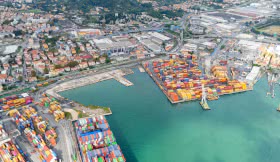
Fedespedi Report, the ports of the North Adriatic are growing, but they speak Slovenian and Croatian
In the first half of 2026, Trieste, Venice, Ravenna and Ancona remain at about 819 thousand TEUs: the growth of the basin comes from Koper and Rijeka
Milano
October 7, 2026
The October 2026 report of the Fedespedi Study Center shows a
Italian foreign trade in recovery, stagnant air cargo and a
maritime transport in which the Middle East crisis is returning to
weigh on freight rates and routes. While a year ago the Economic Outlook of
Fedespedi described a relaxing maritime market, with freight rates
decreasing, ships more punctual, volumes growing, the last
tells another story, starting with the freight rates that have risen since the
low of a year ago to more than double the value. The recovery of
hostility between the United States and Iran and the extension of the conflict
to Yemen, where the Houthis have recently conquered large
portions of the Red Sea coast and the Bab el-Mandeb area
before being countered by the offensive of government forces,
has slowed down the return to normality on maritime routes
between Asia and Europe.
The report provides a snapshot of the trend in the port period
Italians, but only a part: there are nine of them surveyed by
Fedespedi. And here we could open a debate on the scarcity, for
not to say largely insufficient, timeliness with which they are
Official data on traffic handled by ports released
national. A serious fact for a nation that declares itself seafaring.
In the first half of this year, the ports surveyed handled
containerized traffic of 3.02 million TEUs, down by
-0.2% over the same period in 2025, with Genoa at -1.5%, Savona at
-8.0%, Trieste at -4.1%, La Spezia at +3.5%, Venice at +4.6%, Ancona at
+3,0%. This is a recovery compared to -4.6% in the first quarter
2026 reported by the previous report of the Fedespedi Study Center,
which, however, refers to an area of ports partially
different.
The most interesting fact, however, is
in the comparison between the two maritime macro-slopes in which it is
divided the Italian peninsula. The latest report underlines the
"greater dynamism" of the North Adriatic, which in the
half-year growth of +8% (1.855 million TEUs against 1.718 in the
first half of 2025), while the North Tyrrhenian Sea fell by -0.9%.
But the North Adriatic group includes Koper and Rijeka. Adding up the only
Italian Adriatic ports (Trieste, Venice, Ravenna, Ancona) on
traffic is about 819 thousand TEUs in both semesters:
So zero growth. Therefore all the increase comes from the two airports
Slovenian and Croatian dockers, which grew together by about +15%. The
Fedespedi report explains it with the investments of the companies
and with the demand of Eastern Europe: "the strong
increase in handling in the port of Rijeka-Rijeka (+35.7%
Rijeka and +5.2% Koper, ed.) - explains the document - is
due to the full operation of the new Rijeka terminal
Gateway, managed by APM Terminals (Maersk group) together with Enna
Logic (part of the Enna Group, a Croatian investment company,
focused on the energy and logistics sectors). The new
terminal joins the Adriatic Gate Container Terminal (AGCT),
already present in the port and managed by the company
Luka Rijeka'. The report also shows that
in the decade 2015-2025 containerized traffic, on a 2015=100 basis
it rose for the North Adriatic to 138 and for the Tyrrhenian to 116.
It is confirmation that the competition for the European hinterland is
he plays more and more outside the Italian borders.
The report then specifies that "the main ports of the
Mediterranean non-Italians handled a total of 24,882
million TEUs, with a growth of 4.7%".
The report also points out that in the first half of 2026,
Italian exports rose to 337.2 billion euros (+4.5%),
imports at 312.6 (+4.3%), with a surplus of 24.6 billion
against 22.8. This is a clear acceleration compared to +1.3% in the
first quarter (from the cumulative data a second quarter is obtained
2026 around +7.7%). A significant part of this growth is
but from a single voice, that of precious metals and
semi-finished products, exported for 13.7 billion against 5.3 (+157%). From
alone account for about 57% of the overall increase in exports;
without them, growth would be around +2%. The
+39% of exports to Switzerland, one of the world's gold hubs
(In the period, the other typical destinations of gold did not grow:
United Kingdom -5.8%; Turkey -15.5%; Emirates -12.6%). Even the
Precious metals imports rose by +87%.
The report also focuses on air cargo, which at the
The world has been growing steadily for the past year at around +4% (IATA:
+4.1% in August 2025, +4.3% in December, +4.0% in April 2026, +3.9%
in July), a far cry from the +13.6% of July 2024. Airports
Italians do not follow him. After +15.0% in 2024, +1.7% in 2025
and -1.0% in January-April, for national airports
the January-August 2026 period closes at -0.7% (821 thousand tons).
The decline is all in postal traffic (-18.6%), which the
report attributes, as a probable consequence, to the decline in
of e-commerce after the new tax of two euros on packages from the
China.
Overall, the picture drawn by the Fedespedi report is
therefore that of an Italian economy that returns to growth in the
foreign trade, but in which logistics does not follow everywhere
the same dynamic. What emerges is a geography of trafficking in which
international demand offers new opportunities, but the
ability of Italian airports to intercept them does not appear to be
uniform. And it is precisely the comparison with the competing ports of the
Mediterranean and Central and Eastern Europe shows that the
It is not only on the growth of traffic, but on the capacity
to turn the recovery of trade into market shares
logistics.
- Via Raffaele Paolucci 17r/19r - 16129 Genoa - ITALY
phone: +39.010.2462122, fax: +39.010.2516768, e-mail
VAT number: 03532950106
Press Reg.: nr 33/96 Genoa Court
Editor in chief: Bruno Bellio No part may be reproduced without the express permission of the publisher







 The October 2026 report of the Fedespedi Study Center shows a
Italian foreign trade in recovery, stagnant air cargo and a
maritime transport in which the Middle East crisis is returning to
weigh on freight rates and routes. While a year ago the Economic Outlook of
Fedespedi described a relaxing maritime market, with freight rates
decreasing, ships more punctual, volumes growing, the last
tells another story, starting with the freight rates that have risen since the
low of a year ago to more than double the value. The recovery of
hostility between the United States and Iran and the extension of the conflict
to Yemen, where the Houthis have recently conquered large
portions of the Red Sea coast and the Bab el-Mandeb area
before being countered by the offensive of government forces,
has slowed down the return to normality on maritime routes
between Asia and Europe.
The October 2026 report of the Fedespedi Study Center shows a
Italian foreign trade in recovery, stagnant air cargo and a
maritime transport in which the Middle East crisis is returning to
weigh on freight rates and routes. While a year ago the Economic Outlook of
Fedespedi described a relaxing maritime market, with freight rates
decreasing, ships more punctual, volumes growing, the last
tells another story, starting with the freight rates that have risen since the
low of a year ago to more than double the value. The recovery of
hostility between the United States and Iran and the extension of the conflict
to Yemen, where the Houthis have recently conquered large
portions of the Red Sea coast and the Bab el-Mandeb area
before being countered by the offensive of government forces,
has slowed down the return to normality on maritime routes
between Asia and Europe.










 - Via Raffaele Paolucci 17r/19r - 16129 Genoa - ITALY


