
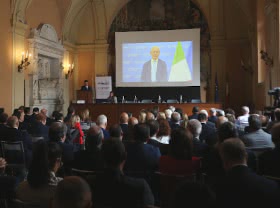
On the occasion of yesterday's meeting in Copenhagen of the executive
Committee of the European Sea Ports Organisation (ESPO), during the
of which the revision of the regulatory framework is addressed
ETS, the Emissions Trading System
of the EU, the Association of Italian Ports (Assoporti) has supported
the need to recognize the islands as well
a discipline capable of taking into account their
specificity, avoiding that the application of the ETS leads to
distorting effects on continuity and competitiveness
of island maritime connections.
Communicating the results of the meeting, at which the President
of the Port System Authority of the Sicilian Sea
Annalisa Tardino, participated in representation and
support for Assoporti's positions, the association announced
that a significant achievement was the birth,
within ESPO, the new network "Outermost Regions and
Islands" dedicated to the outermost regions and islands.
The goal is to create a permanent headquarters in which the ports
can address common challenges and develop
shared positions on European policies that present
particular repercussions on these territories. Assoporti specified
that the same documentation of the ESPO executive committee
expressly identifies among the topics of interest of the new network
both the EU ETS, the Onshore Power Supply obligations, the
technology that allows ships in ports to connect
directly to the terrestrial electricity grid, and connectivity
with the hinterland as part of the trans-European transport network
TEN-T, highlighting the need to develop positions
to be subsequently represented to the institutions and
European regions. The Association of Italian Ports has highlighted
whereas the establishment of this new body therefore represents
an important step and confirms the need, supported by
with continuity by Assoporti, to ensure the realities
a specific and recognisable voice in the decision-making process
European.
"The Copenhagen confrontation - noted Annalisa Tardino
- marks an important step because it finally leads to the
European debate, in a more structured way, the
islands and their ports. The issue of the ETS is not
abstract: it concerns the continuity of connections, the
competitiveness of enterprises and, more generally, the
right of an island territory not to be penalized by the
geographical condition. Bringing this specificity
within ESPO means moving the issue away from the
national to the European one, which is the place in which they must
solutions to be identified. The birth of the dedicated network
to the islands and the outermost regions - Petri observed - is,
In this sense, a concrete result: for the first time these
reality will have a stable space in which to systematize
common needs and transform them into proposals to be submitted to the
institutions. The work we are carrying out with
Assoporti goes in this direction: do not question the
objectives of the environmental transition, but to ensure that they are
pursued without creating new penalties for the territories
islands'.
"The result achieved in Copenhagen - underlined the
president of Assoporti, Roberto Petri - confirms how much
It is important to be present and work continuously in the
European tables. The issue of the islands, but not only, cannot be
be addressed by applying indiscriminately rules designed to
profoundly different territorial realities. The work carried out
by Assoporti, together with the president Annalisa Tardino and in the
comparison with ESPO, aims precisely to make this
specificity and to translate it into concrete proposals in the
European Unions. The establishment of a space specifically dedicated to
outermost regions and islands also represents
an important opportunity: it will allow us to build
common positions and to give greater strength to the demands of the ports
in dialogue with the institutions of the Union'.















 - Via Raffaele Paolucci 17r/19r - 16129 Genoa - ITALY


