
The Italian Association of Port Terminal Operators (Assiterminal)
confirms its support for the government's plan to reform the
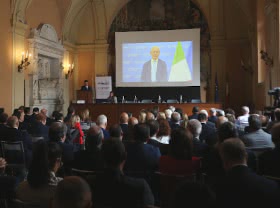
port legislation. During the last council meeting
held in Genoa with the participation extended to all
member companies, the contribution of various stakeholders and
representatives of the institutions, referring to the procedure for
evaluation of the bill C. 2925 currently under examination by the
IX Transport Commission of the Chamber of Deputies, the association specified
that "in the current phase of the parliamentary debate,
Assiterminal confirms the positive evaluation of the route
undertaken with the aim of providing Italy with a strategic strategy
for the development of the port system
national team".
However, Assiterminal also reported three main
criticality of the measure, starting from the role of the
Port System Authority and the attractiveness of the
private investments. The association noted that, "according to
the current wording, port concessions would continue
formally to be issued by the System Authorities
Portuale. However, if Ports of Italy (the new company
that the bill proposes to establish for
to concentrate at national level the planning and above all the
construction of major port infrastructure works, ed.)
was also in charge of carrying out "hot works", what
which would risk partially replacing the current function of the
the identification of the entity called upon to manage the
terminal would essentially be within the competence of Ports of Italy,
considering that management would represent the instrument through
which remunerates the investments made for the construction
of the works. The Port Authorities - observed Assiterminal - would remain
therefore the merely formal function of a state-owned nature.
An approach that recalls, albeit in a different context and without
the presence of Ports of Italy, what has already been experimented for
some works under construction, with the related problems
of a legal nature that are still unresolved. In addition, the mechanism of
remuneration of works through the "tariffs" of the
terminal would end up substantially shifting the burden to the
maritime customer. This arrangement could adversely affect
on the attractiveness of private investment in the system
port sector".
Assiterminal also invites you to clarify the roles between
grantor and concessionaire. "The text - explained
the association - allows Porti d'Italia to grant the
works that are the subject of the concession of which it is
foster carer. This ends up concentrating in a single subject
the qualification of concessionaire (of a service of interest
general economic value) and grantor in relation to the exact same
object. This aspect lends itself to potential critical issues
from the point of view of European law, also by virtue of a
overlap with the Port System Authority (whose
discipline would be "postponed" to a possible
coordination agreement) which risks generating uncertainty on the
governance plan and their respective responsibilities".
He then noted that "some provisions of the draft of
law have a retroactive application in relation to concessions
and relationships already in place, the association of terminal operators
considers that 'these provisions should be deleted,
as several amendments tabled have proposed. In the absence of
such suppression - specified Assiterminal - would risk
there is a strong legal uncertainty and a consequent
disincentive to investment. There are - he pointed out
THE ASSOCIATION - Several amendment proposals, at the moment
set aside, which could favor median solutions in any case
sustainable, such as, by way of example, 9.121 and 29.16".
Assiterminal therefore believes that "it is essential that the comparison
on the reform continues with the current debate
while preserving its strategic objective of strengthening the
competitiveness and the unitary vision of the port
but by intervening on the elements that could generate
critical issues in terms of governance, certainty
and the attractiveness of private investments".


















 - Via Raffaele Paolucci 17r/19r - 16129 Genoa - ITALY


