
"For a terminal operator, dredging is not only
an environmental or technical issue: it is a condition
essential to ensure the operation of the berth,
commitments made to shipowners and maintain the
competitiveness of the port". Stefano underlined this
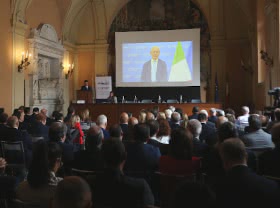
Mordeglia, general manager of Servizi Industriali Genova SIGE,
spoke on behalf of the Italian Association
Port Terminal Operators (Assiterminal) at the dedicated technical session
"Sediments, dredging and reuse" held today in Ferrara
as part of RemTech Expo.
"The variable that governs the competitiveness of a
terminal - specified Mordeglia - is not the seabed
but the certainty of the seabed available when the ship
arrives. A meter of draught that is missing that day can
result in lightening of the load, waiting for the tide, less
payload or, in the worst cases, diversion to another
port". Hence the need, according to Assiterminal, to
overcome a logic of episodic interventions and ensure for each
Port System Authority structural planning and
of maintenance dredging, with volumes, destinations
of materials and financial coverage, together with
multi-year authorizations and certain times for the approval of the
material management projects.
The representative of Assiterminal explained that another
a central aspect is the relationship between the seabed and the state of the
docks, given that the deepening of the seabed in front of works
may affect the geotechnical conditions and the
infrastructure security often built several decades ago and
today subjected to increasing stresses, also as a result of the
dimensions and power of new generation ships. For
This, according to the association, a dredging project cannot
concern only the sediment, but must also consider the state
and the stability of the quay. System Authority
The port and concessionaires should also build a
real "approach file", through
periodic bathymetry, underwater inspections and monitoring of
infrastructure.
For Assiterminal, moreover, the maintenance of the seabed should
be managed, as in the large ports of Northern Europe, as
a recurrent industrial process, through monitoring and
planning of interventions and destinations of materials.
Finally, the destination and reuse of sediments is central:
reclaimed areas, nourishment, transfers and the possibility of
should be planned together with the
excavation, because without a certain outlet for the materials even
the simplification of procedures risks not resulting in a
greater availability of the seabed.
"The terminal operator - concluded Mordeglia - does not need it
just a simpler rule. We need a rule
predictable. If I know when and how much we dredge, I can sign a
contract. If I don't know, I can't."
















 - Via Raffaele Paolucci 17r/19r - 16129 Genoa - ITALY


