
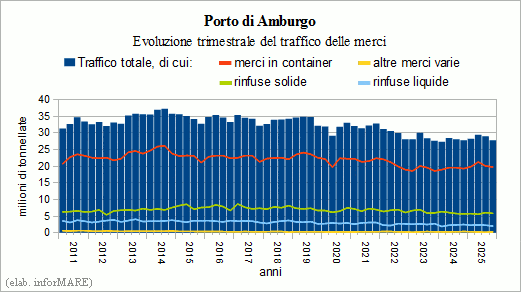
Last year the traffic of the goods in the port of Amburgo has recorded an increment of +2.6% on 2024 going up to 114,6 million tons that is generated in the first three quarters of 2025, while in the last trimester period the total volume of cargos is almost stable regarding the fourth trimester of the 2024 being piled to approximately 27,8 million tons. In the period October-December of 2025 is grown both the containerized goods, attested to 19,8 million tons (+3%) with a handling of containers pairs to beyond two million teu (+4%), and the solid bulk with 5,8 million tons (+3%). They are diminished, instead, the liquid bulk, pairs to two million tons (-18%), and the goods conventional with about 300 thousand tons (-24%).
In the entire 2025 the traffic of the container has been of 81,1 million tons, with a rise of +4.6% on the previous year, volume that is realized with a handling of containers pairs to 8,3 million teu (+7.3%). the harbour authority of the German port of call has announced that the increment of the traffic of the container has been drawn mainly from the traffic with China (+6.5%), Malaysia (+84.3%) and India (+49.2%), and also with the north-European region (Finland, Denmark, Norway, Sweden) that it is important for the traffic of transhipment (+21.2%). The containerized traffic with the United States, instead, has recorded an opposite trend, with a decrease of -25.6% that the harbour agency has attributed, among other factors, to the high duties introduced from the USA. The conventional goods were pairs to 1,1 million tons (-15.4%).
In the field of the bulk, where with a total of 32,4 million tons has been accused a decrease of the -1,7% on 2024, the only liquid cargos have marked an increase of +0.7% having been pairs approximately nine million tons, while the solid ones, with 23,3 million tons, are diminished of the -2,7%. In particular, cereal traffic has decreased by -45.8% due to the reduction of exports and in bending are also results fertilizers (-5.6%) and minerals (-4.3%). In increase the construction materials (+19.5%), the other solid bulk (+17.1%) and chemicals (+16.3%).



















 - Via Raffaele Paolucci 17r/19r - 16129 Genoa - ITALY


