Independent journal on economy and transport policy
11:52 GMT+1
This page has been automatically translated by Original news
SHIPPING
IMO Council deliberates to establish a safe corridor in the Strait of Hormuz, but by "peaceful means and on a voluntary basis"
Dominguez: concrete actions are needed from all countries and stakeholders
Londra
March 20, 2026
The extraordinary session of the Council of the International
Maritime Organization met on Wednesday and yesterday in London to
discuss the situation in the Strait of Hormuz region
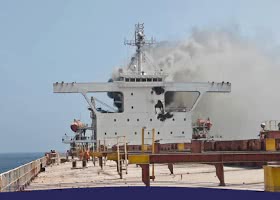
where attacks on ships follow one another in the context of the conflict
pitting the United States and Israel against Iran has
concluded yesterday evening with a resolution urging the establishment of
a safe corridor to allow the evacuation of ships still
locked in the area.
The resolution specifies that, "with regard to the proposal
to encourage the establishment of a framework to facilitate
the safe evacuation of merchant ships contained in the
document C/ES.36/3/4 submitted by Bahrain and Others, the Council,
taking into account the significant number of merchant ships
remain stuck in the region, encouraged the institution, in
temporary and urgent way, of a framework, such as a corridor
safe maritime transport, to facilitate the safe evacuation of
merchant ships from high-risk areas and hit to a
safe place, with particular attention to those currently
confined to the Gulf region, through peaceful means and on
voluntary basis. This measure aims to protect the lives of seafarers
and to ensure the mobilisation and commercial navigation of
ships that intend to use this framework, avoiding attacks on
military and protecting and securing the
maritime. The Council also invited the Secretary-General to
work with stakeholders and adopt the necessary
immediate measures to start the definition of the framework and to keep
Member States of developments, as well as
submit a report to a future Council meeting'.
It is quite clear that the implementation of this
initiative "through peaceful means and on a voluntary basis"
can be a powerful disincentive for many governments to
engage in this action. The Secretary-General of the IMO
urged everyone to intervene: "It is the responsibility of the
of each of us - said Arsenio Dominguez - to demonstrate that
Inaction is not an option, that words alone are not enough.
Together we can drive the change needed to protect
the well-being of those who have no voice and safeguard the
principle of freedom of navigation". Dominguez has
said 'ready to immediately start negotiations for
establish a humanitarian framework for the evacuation of all vessels, and
the seafarers trapped. However - he specified - in order for
this becomes concrete, I will need understanding,
commitment and, above all, concrete actions by all
countries and stakeholders'.
The Council also called for the immediate cessation of
all attacks on ships targeting civilian seafarers
and called on Member States to ensure the supply of
water, food, fuel and other essential goods to the
ships currently unable to leave the region. The States
They were also encouraged to facilitate foreign exchange operations
of crews in accordance with the
in order to safeguard the health, safety and
the well-being of seafarers. The Council urged States to
ensure that seafarers can maintain communications with the
their families and friends and that supplies and supplies are
adapted to their needs.
For the Secretary General of the International Transport Workers'
Federation (ITF), Stephen Cotton, is now the government's
time to act: "for the thousands of seafarers still
trapped in this region, which they face on a daily basis
Threats to one's own life - he underlined - words are not enough.
What matters now is concrete and urgent action that
protect their safety, their health and their dignity".
"We welcome the commitment to the
Gulf States to ensure the supply of essential goods
ships in the region, as well as their efforts to facilitate
the change of crews and the repatriation of seafarers. But let it be well
clear: the goal of all governments must be the protection of
seafarers, innocent civilians. As we stated during the
all flag States shall immediately issue
clear and unambiguous warnings to ship owners and operators
to avoid sailing to the war zone or
transit through it. No seafarer should be put in a position
of having to navigate through an ongoing conflict".
On the proposal to establish a corridor
to facilitate the safe evacuation of
ships from the Gulf region, Cotton has
specified that "the ITF supports the development of corridors
safe evacuation seafarers, provided - specified the
General Secretary of the Trade Union Organization - whether he is
their effective safety in practice, and not only in
in principle'.
- Via Raffaele Paolucci 17r/19r - 16129 Genoa - ITALY
phone: +39.010.2462122, fax: +39.010.2516768, e-mail
VAT number: 03532950106
Press Reg.: nr 33/96 Genoa Court
Editor in chief: Bruno Bellio No part may be reproduced without the express permission of the publisher