Independent journal on economy and transport policy
15:28 GMT+2
This page has been automatically translated by Original news
PORTS
Quarterly traffic fell slightly in the port of Rotterdam, with boarding volumes almost making up for the reduction in landings
The effect of the closure of the Strait of Hormuz expected from the second quarter
Rotterdam
April 22, 2026
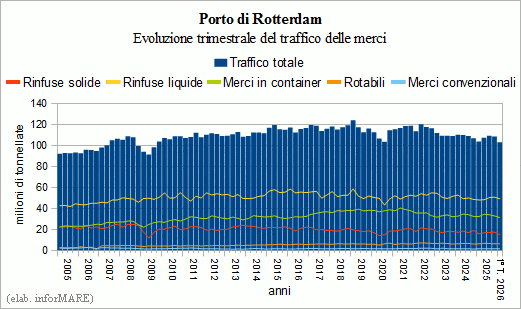
In the first three months of 2026, the traffic of goods in the port of
Rotterdam was 103.0 million tonnes, with a
limited decrease of -0.7% on the same period last year, which
was generated by the -1.8% reduction in goods at the
landing, amounting to 72.9 million tonnes, which was
partially offset by the +2.0% increase in those
at the end of the year, which amounted to 30.1 million tonnes, and in
increase of +13.1% in shipments of liquid bulk cargo.
In the container sector alone, total traffic is
state of 31.2 million tonnes (-3.2%) and was
built with a container handling of 3.37 million
of TEU (+0.3%). Other miscellaneous goods amounted to 7.7 million
of tonnes (-1.5%), of which 6.3 million tonnes of rolling stock
(+1.6%) and 1.4 million tons of other cargo (-13.3%). The
Liquid bulk cargo totaled 49.1 million tons
(+2.2%), of which 25.2 million tonnes of crude oil
(+1.7%), 12.9 million tonnes of petroleum products
refined (+10.3%), 3.2 million tonnes of natural gas
liquefied cargo (+1.7%) and 7.8 million tons of other bulk cargo
liquid (-7.2%). In the dry bulk sector, the figure
was 15.0 million tonnes (-4.3%) and
includes 5.4 million tonnes of minerals and scrap (+5.3%), 4.0
million tons of coal (-9.8%), 2.4 million tons
of agricultural products (-20.9%) and 3.1 million tonnes of other
dry bulk (+4.6%).
Regarding the sharp drop in the traffic of agricultural products,
the Port Authority of Rotterdam explained that it is in
largely due to a return to normal levels, given that the
Last year, there was a temporary increase in volumes
shipped through the Dutch port. The decline of -9.8%
is mainly attributable to the decrease in
of the volume of energy coal as a result of the exceptional levels of
recorded in 2025, while in 2026 it returned
at the usual levels. As for liquid bulk cargo, the port authority has
The increase in exports of products
oil prices and the simultaneous reduction of imports, a trend
divergent differences which, according to the Authority, could be linked to the
fact that, as in 2025, most petroleum products
was in backwardation, with spot prices of the most
than expected in the future, which does not incentivise their
storage. The body also noted that it was
there was also an increase in diesel exports to
Spain and Gibraltar and this could be due to the fact that
the Mediterranean is now an ECA control area of
emissions, where the sulphur content of the marine fuel must not be
exceed 0.1%.
Regarding the effect on the port of Rotterdam of the closure
of the Strait of Hormuz, the port authority of the Dutch port of call
explained that a total of 19 million tons of goods,
accounting for 4.4% of the total annual traffic in Rotterdam, comes from
Persian Gulf countries and it is mainly oil
raw from Iraq and Saudi Arabia, kerosene from Kuwait,
fuel oil from Saudi Arabia and diesel from Qatar. Gas
liquefied natural from Qatar does not reach
Rotterdam, where two-thirds come from the United States. Observing
whereas Asia is more dependent on oil imports
crude oil and petroleum products from the Middle East compared to Europe
and that the blockade of the Strait of Hormuz led to a rapid
increase in the prices of petroleum products in Asia, the port authority
specified that this increase was greater than
Europe because of its increased dependence on the Middle East and
whereas, due to higher prices in Asia, at least five
tankers bound for Rotterdam changed course heading for
to Asia.
He then specified that the Dutch port depended on the countries of the
Persian Gulf for 10% of its crude oil traffic and for
14% of its traffic in petroleum products, the port authority has
announced that the impact of the closure of the Strait on traffic
of goods handled in Rotterdam is barely perceptible in the
data for the first quarter of 2026, but - he specified
the CEO of the authority, Boudewijn Siemons -
"It could become more pronounced in the second quarter."
On the other hand, the expected impact of the closure of
Hormuz on the container sector, given that the traffic
containerized directly and from the Middle East represents
1.2% of the total volume handled in Rotterdam. However - he
warned the Authority - the indirect effects of the war on the
container industry could have a much greater impact than
economic recession and declining purchasing power.
- Via Raffaele Paolucci 17r/19r - 16129 Genoa - ITALY
phone: +39.010.2462122, fax: +39.010.2516768, e-mail
VAT number: 03532950106
Press Reg.: nr 33/96 Genoa Court
Editor in chief: Bruno Bellio No part may be reproduced without the express permission of the publisher







 In the first three months of 2026, the traffic of goods in the port of
Rotterdam was 103.0 million tonnes, with a
limited decrease of -0.7% on the same period last year, which
was generated by the -1.8% reduction in goods at the
landing, amounting to 72.9 million tonnes, which was
partially offset by the +2.0% increase in those
at the end of the year, which amounted to 30.1 million tonnes, and in
increase of +13.1% in shipments of liquid bulk cargo.
In the first three months of 2026, the traffic of goods in the port of
Rotterdam was 103.0 million tonnes, with a
limited decrease of -0.7% on the same period last year, which
was generated by the -1.8% reduction in goods at the
landing, amounting to 72.9 million tonnes, which was
partially offset by the +2.0% increase in those
at the end of the year, which amounted to 30.1 million tonnes, and in
increase of +13.1% in shipments of liquid bulk cargo.










 - Via Raffaele Paolucci 17r/19r - 16129 Genoa - ITALY


