Independent journal on economy and transport policy
20:32 GMT+2
This page has been automatically translated by Original news
PORTS
Cognolato (Assiterminal): the reform of port governance must take place in a truly participatory way
A condition of uncertainty has been created that slows down decisions and weakens the entire system
Genova
April 17, 2026
"The Prime Minister, Giorgia Meloni, reiterated
once again the strategic centrality of the economies of the
and the need for a clear and coherent vision. The
Minister Nello Musumeci, together with the other institutional speakers,
recalled the importance of building a shared path,
capable of systematizing skills, tools and responsibilities,
as was the case for the Sea Resource bill. However, the
path started on the reform of port governance does not seem to be
having followed this logic of sharing to the end". The
noted Tomaso Cognolato, president of Assiterminal and contact person
of ports in the GT Economy of the Sea of Confindustria coordinated by
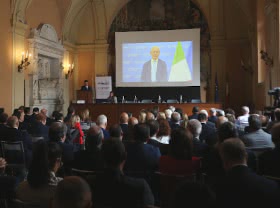
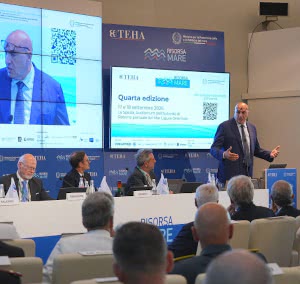
Mario Zanetti, speaking today in Genoa at the event "Genoa and
Liguria: Capitals of the Sea 2026 - The Blue Engine of Growth
economic and employment" promoted by Confindustria.
"The measure - specified Cognolato - is
was set up without a full involvement of the actors of the
sector and, to our knowledge, has not yet completed its
process at the State Accounting Office. This situation has in fact
led to a slowdown, if not a block, of many initiatives
and operational processes of the Port System Authorities, which
They are now in a phase of waiting and uncertainty. For this reason,
We believe it is essential to reopen a structured and concrete discussion
at the national level, by activating a collaboration table that
aligns strategic vision, regulatory tools and
implementation capacity".
"We fully agree - specified the president
of the Italian Association of Port Terminal Operators - the objectives
indicated by the government: to strengthen the role of the port system,
make it more efficient and competitive, and equip it with a
Stronger governance. But precisely for this reason it is
it is necessary that the path is built and managed in a truly
participated. We need a strong central direction, but also
of a system that is shared, stable and immediately
operational. Otherwise, the risk is what we are already
Seeing today: a condition of uncertainty that slows down decisions
and weakens the entire system."
Cognolato also dwelt on the issue of
"Ours," he observed, "is an area
highly specialized, in which the training course,
insertion and start to work is structured and regulated. In
Italy, this system is based on a precise pillar: the contract
national labour collective of the port sector, shared between
companies and trade unions, which over time has guaranteed
balance, stability and business continuity. Up to
a few months ago, despite the physiological confrontation between the social partners -
he pointed out - the system worked: we negotiated, we found
agreements and operated within a certain framework. Today, however,
A significant criticality has opened up, as we denounce
for months now. Some guidelines on holiday pay
resulting from decisions at European level, progressively transposed
also by Italian jurisprudence, are producing effects that
go far beyond the specific cases for which they were originally
thought. The real risk is that these guidelines will be
also extended to different contexts, affecting
structured and stable jobs, such as those of the port system. The
consequences - underlined the president of Assiterminal -
could be very significant, also in economic terms,
with potential impacts in the order of hundreds of millions of euros
for the system. But above all, an essential element is missing: the
legal certainty. If a collective agreement, legitimately
signed between the parties, may be called into question
ex post, it becomes difficult to plan, invest and guarantee
Business continuity. For this you need a
clarification intervention. We need a unified position, both from
trade unions both by the Government and by the
reaffirms the validity of the contract and protects its system.
The point is simple: either you fully recognize the value of the
collective agreement signed - concluded Cognolato - or
a path to redefine it formally opens. But you can't
leave the system in a gray area of uncertainty."
- Via Raffaele Paolucci 17r/19r - 16129 Genoa - ITALY
phone: +39.010.2462122, fax: +39.010.2516768, e-mail
VAT number: 03532950106
Press Reg.: nr 33/96 Genoa Court
Editor in chief: Bruno Bellio No part may be reproduced without the express permission of the publisher







 "The Prime Minister, Giorgia Meloni, reiterated
once again the strategic centrality of the economies of the
and the need for a clear and coherent vision. The
Minister Nello Musumeci, together with the other institutional speakers,
recalled the importance of building a shared path,
capable of systematizing skills, tools and responsibilities,
as was the case for the Sea Resource bill. However, the
path started on the reform of port governance does not seem to be
having followed this logic of sharing to the end". The
noted Tomaso Cognolato, president of Assiterminal and contact person
of ports in the GT Economy of the Sea of Confindustria coordinated by
Mario Zanetti, speaking today in Genoa at the event "Genoa and
Liguria: Capitals of the Sea 2026 - The Blue Engine of Growth
economic and employment" promoted by Confindustria.
"The Prime Minister, Giorgia Meloni, reiterated
once again the strategic centrality of the economies of the
and the need for a clear and coherent vision. The
Minister Nello Musumeci, together with the other institutional speakers,
recalled the importance of building a shared path,
capable of systematizing skills, tools and responsibilities,
as was the case for the Sea Resource bill. However, the
path started on the reform of port governance does not seem to be
having followed this logic of sharing to the end". The
noted Tomaso Cognolato, president of Assiterminal and contact person
of ports in the GT Economy of the Sea of Confindustria coordinated by
Mario Zanetti, speaking today in Genoa at the event "Genoa and
Liguria: Capitals of the Sea 2026 - The Blue Engine of Growth
economic and employment" promoted by Confindustria.









 - Via Raffaele Paolucci 17r/19r - 16129 Genoa - ITALY


