Independent journal on economy and transport policy
12:36 GMT+2
This page has been automatically translated by Original news
SHIPPING
After years of sustained growth, short sea shipping in Spain has entered a phase of structural slowdown
This is revealed in the latest report of the Observatorio Estadístico del Transporte Marítimo de Corta Distancia
Madrid
May 18, 2026
In 2025, short sea shipping services in Spain have
transported a total of 257.5 million tons of cargo,
with a decrease of -4.3% compared to 269.1 million tons
in the previous year, which is mainly driven by traffic
fell by -6.4% to the lowest level of the
in recent years, even lower than that of 2020, while the
national cabotage recorded a growth of +2.9%. He notes it
the latest report of the Observatorio Estadístico del
Transporte Marítimo de Corta Distancia elaborated
by the Asociación Española de Promoción del
Transporte Marítimo de Corta Distancia, which highlights how in
Spain, after years of sustained growth, maritime transport in
short-range has entered a phase of structural slowdown.
Last year, almost half of the maritime transport to
with Spain (48.9%) was made up of bulk cargo (125.9
million tonnes) and the other half (51.1%), from miscellaneous goods
(131.7 million tonnes) distributed among containerised goods (65 million tonnes)
million tonnes), ro-ro freight (55.9 million tonnes) and
conventional goods (10.8 million tons). Compared to 2024,
Solid and liquid bulk traffic has changed
miscellaneous: liquid bulk traffic (83.8 million tonnes)
remained stable, while that of dry bulk (42.1
million tonnes) decreased by -14.0%. Traffic
overall general cargo decreased by -3.4% due to the
significant reduction (-9.1%) in containerized traffic, while
conventional freight traffic increased by +5.7% and
a slight positive change (+2.2%) was recorded
also from ro-ro traffic.
According to the report, the main breaking with respect to
previous years is represented by the impact of the new
European and international environmental regulations on transport
maritime system, with the entry into force of the IMO standards, the
EU ETS emissions trading and the EU Regulation
FuelEU Maritime that would have profoundly changed the balance
between maritime transport and road transport. In
In particular, the report notes that if in the period 2013-2019 the
growth in short sea shipping in Spain had been higher than
that of road transport, with an average annual increase of
respectively at +7.8% and +4.6%, and a coefficient of
correlation of 0.95, in the period 2021-2025, with the entry into force of
in 2020 of the new IMO regulation on the upper limit of the
sulphur in marine fuels and after application to the
maritime in 2024 and 2025 of the ETS and the FuelEU Regulation,
The evolution was the opposite: +2.1% average annual increase
of road transport against the -2.3% drop in short sea
shipping and a correlation coefficient of -0.64.
The report also points out that in 2025 the supply of
Ro-Ro maritime services, in terms of capacity, is
decreased on both the Atlantic and Mediterranean coasts, with
the first which recorded a decrease of -16.6% from three
to 2.5 million linear metres, while in the Mediterranean the decline is
-11%, from 6.4 to 5.7 million linear metres. The document
explains that shipping companies are reacting to the
contraction of demand by reducing frequencies and services: in the second
Half of 2025, 14
services operated by seven companies with 34 ro-ro vessels; in the
Mediterranean five companies covered 13 maritime lines with 31
naval units. The Motorways of the Sea also showed
signs of weakening and in 2025 the overall capacity
of these services decreased by -12.8%, with the coast
which has lost two connections, with a reduction in the
capacity of -22.6%, while the Mediterranean limited the
drop to -5.7% thanks mainly to traffic with North Africa.
On the demand side, ro-ro traffic last year
international sector recorded a reduction of -0.8% to
25.1 million tons. The report specifies that, however, the
This figure hides strong differences between the Atlantic coast (-8.7%) and
the Mediterranean (+0.6%). What weighs above all is the
slowdown in traffic with some European countries: connections
with Belgium have collapsed by -26.4%, those with Italy by
-6.0% and those with the United Kingdom by -2.2%. In contrast to the trend, the
Morocco, which grew by +4.6%, confirming itself as one of the
more dynamic markets for the Spanish maritime system.
The commercial vehicle segment is also in difficulty
transported which is an important component of the traffic
international ro-ro. In 2025, the sector, with 3.2 million
tonnes transported, equivalent to approximately 1.4 million vehicles,
recorded a contraction of -7.7%. The decline concerned
in particular the Mediterranean coast (-18.4%) and embarkations
(-14.7%, while the Atlantic coast showed growth of
+3.4%, with shipments up +12.2%.
- Via Raffaele Paolucci 17r/19r - 16129 Genoa - ITALY
phone: +39.010.2462122, fax: +39.010.2516768, e-mail
VAT number: 03532950106
Press Reg.: nr 33/96 Genoa Court
Editor in chief: Bruno Bellio No part may be reproduced without the express permission of the publisher







 In 2025, short sea shipping services in Spain have
transported a total of 257.5 million tons of cargo,
with a decrease of -4.3% compared to 269.1 million tons
in the previous year, which is mainly driven by traffic
fell by -6.4% to the lowest level of the
in recent years, even lower than that of 2020, while the
national cabotage recorded a growth of +2.9%. He notes it
the latest report of the Observatorio Estadístico del
Transporte Marítimo de Corta Distancia elaborated
by the Asociación Española de Promoción del
Transporte Marítimo de Corta Distancia, which highlights how in
Spain, after years of sustained growth, maritime transport in
short-range has entered a phase of structural slowdown.
In 2025, short sea shipping services in Spain have
transported a total of 257.5 million tons of cargo,
with a decrease of -4.3% compared to 269.1 million tons
in the previous year, which is mainly driven by traffic
fell by -6.4% to the lowest level of the
in recent years, even lower than that of 2020, while the
national cabotage recorded a growth of +2.9%. He notes it
the latest report of the Observatorio Estadístico del
Transporte Marítimo de Corta Distancia elaborated
by the Asociación Española de Promoción del
Transporte Marítimo de Corta Distancia, which highlights how in
Spain, after years of sustained growth, maritime transport in
short-range has entered a phase of structural slowdown.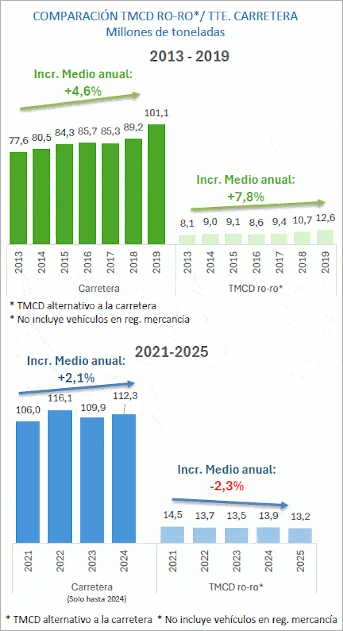












 - Via Raffaele Paolucci 17r/19r - 16129 Genoa - ITALY


