Independent journal on economy and transport policy
12:40 GMT+2
This page has been automatically translated by Original news
PORTS
Gioia Tauro is in second place in the ranking of the main Italian ports, surpassing Genoa
Trieste confirms itself at the top of the standings
Roma
May 11, 2026
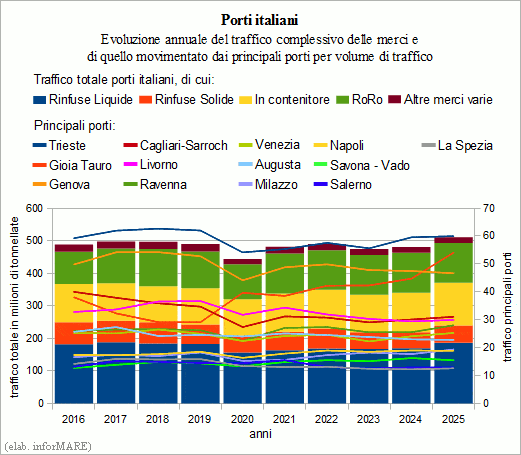
If last year, with a total of 60.0 million tons
and an increase of +0.7% over 2024, the port of Trieste
confirmed its position as the first Italian port of call in terms of volume of
total freight traffic, the port of Gioia Tauro, with 54.1
million tons (+20.8%) overtook that of Genoa
settling in second place in the national ranking.
The Association of Italian Ports (Assoporti) today released the
data on traffic handled in 2025 by national ports, which is
amounting to a total of 510.8 million tonnes, in particular
growth of +3.5% on the previous year, of which 186.3 million
tonnes of liquid bulk (+1.8%), 53.0 million tonnes of
bulk cargo (+7.1%), 131.9 million tonnes of cargo in
containers (+8.1%) made with container handling
equal to 12.8 million TEUs (+7.1%), 122.2 million tonnes of
rolling stock (+0.4%) and 17.5 million tonnes of other freight
(+0,1%).
In the passenger sector, last year in Italian ports there were
A total of 75 million (+2.1%) transited, of which 41.6 million
transported by local maritime services (+3.5%), 18.9 million
embarked on ferries (-1.9%) and 14.4 million embarked on ships
cruise (+3.4%).
The latest issue of "Ports Infographics", research that
collects and analyzes the main transport statistics
maritime transport, logistics and national ports and
and is carried out by Assoporti in collaboration with
with SRM, dedicates a special focus to raw materials, highlighting
the growing weight of liquid and solid bulk in trade
global maritime issues and the strategic role of the Mediterranean in the new
commercial geographies.
Commenting on the findings of the latest edition of the document, the
president of Assoporti, Roberto Petri, highlighted that "the
The picture that emerges confirms the solidity of the port system
in an extremely complex international context. In the
2025 our ports have exceeded 500 million tons of
goods handled, with growth in all product segments
and 75 million passengers transited through Italian airports. They are
Numbers - he underlined - that demonstrate the strategic value of the
infrastructure for the national economy, for trade
and for the competitiveness of the production system
of the country. In a global scenario marked by geopolitical tensions
and redefinition of maritime routes, becomes even more
It is important to continue to invest in infrastructure, sustainability
and logistical efficiency. For this reason, as Assoporti we believe
It is essential to work on data and research for programming
of our nation".
"The analyses we have conducted, thanks to the solid
collaboration with Assoporti - noted the general manager of
SRM, Massimo Deandreis - highlight the strategic value
of the great maritime chokepoints for the global economy. We have
test with the geopolitical tensions and disruptions that are
affecting Hormuz and the consequent effects on supply chains,
logistical costs and on the organization of maritime and
international energy sources. However, the analysis highlights
that Italian ports are demonstrating important capabilities
adaptation, ensuring support for both the industrial system and the
the national tourist one. Despite the general situation, the
data show that the Mediterranean remains central
strategic at a global level and Italy, thanks to its position
and the port network, can play an increasingly important role in the
more relevant in the new logistical balances".
- Via Raffaele Paolucci 17r/19r - 16129 Genoa - ITALY
phone: +39.010.2462122, fax: +39.010.2516768, e-mail
VAT number: 03532950106
Press Reg.: nr 33/96 Genoa Court
Editor in chief: Bruno Bellio No part may be reproduced without the express permission of the publisher







 If last year, with a total of 60.0 million tons
and an increase of +0.7% over 2024, the port of Trieste
confirmed its position as the first Italian port of call in terms of volume of
total freight traffic, the port of Gioia Tauro, with 54.1
million tons (+20.8%) overtook that of Genoa
settling in second place in the national ranking.
If last year, with a total of 60.0 million tons
and an increase of +0.7% over 2024, the port of Trieste
confirmed its position as the first Italian port of call in terms of volume of
total freight traffic, the port of Gioia Tauro, with 54.1
million tons (+20.8%) overtook that of Genoa
settling in second place in the national ranking.











 - Via Raffaele Paolucci 17r/19r - 16129 Genoa - ITALY


