
After a downturn that began in the second half of 2014,
2024, in the first quarter of this year the company's profits
d'Amico International Shipping have returned to growth thanks to a
increase in revenues generated by the increase in sea freight rates for
effect of geopolitical tensions. "During the first
quarter of 2026 - explained the CEO of the
DIS, Carlos Balestra di Mottola - geopolitical developments have
continued to have a significant impact on global markets
of energy and maritime transport of oil, generating
substantial inefficiencies and dislocations. The freight rates and values of the
ships, which had already been strengthened during the course of the
of 2025 and early 2026, have undergone a further
acceleration following the start of hostilities in Iran.
In particular, the war in Iran and the consequent disruptions of the
flows through the Strait of Hormuz - a strategic node
fundamental for the global supply of oil - have
had a significant impact on tanker markets.
Before the conflict in 2025, daily transits through the
amounted to about 15 million barrels per day of
crude oil and five million barrels per day of refined products
(equal to about 19% of global oil supply). The high
number of ships stranded inside the Persian Gulf has led to
a significant contraction in transport capacity,
while the drop in volumes transiting the Strait has generated serious
fleet relocations and a profound reconfiguration of the
trade routes. Consequently - continued Balestra di
Mottola - freight rates have increased sharply, reaching
exceptionally high levels on several routes, sustained
from the lengthening of travel distances, from the limited
availability of ships, by a reduction in the efficiency of the
fleet due to increased port congestion and an increase in
of the percentage of days sailed in ballast, as well as
from the increase in refining margins, which has created favorable
arbitrage opportunities".
"If the conflict does not last long - he said
noted the CEO of the DIS - it is also likely that, a
once concluded and with the reopening of the Strait of Hormuz,
generate a particularly strong market. Releases by the IEA
of about 400 million barrels from strategic reserves (on a
total of about 1.2 billion barrels), at a rate of about 2.0
million barrels per day, along with the redirection of flows
of crude oil through pipelines by Saudi Arabia and
United Arab Emirates for an additional 4.0 million barrels per day,
as well as the reduction in demand resulting from higher prices
and government measures to contain oil
consumption, have reduced the oil supply deficit, which
however, it remains significant and has already resulted in a strong
reduction of commercial oil stocks. These stocks will have to
be reconstituted, both commercial and strategic,
and, depending on the evolution of the conflict, probably at levels
higher than the previous ones, due to the increase in the
perceived risk of further wars in Iran and increased
awareness of the economic vulnerabilities to them
associates. This should support demand for tankers
for several months after the end of the conflict."
The other scenario, that of a protracted conflict, has
observed Balestra di Mottola - "would however lead to prices
significantly higher than those
observed so far, when stocks have reached levels
critics. The resulting economic consequences could be
so serious that we believe that all parties will try to
avoid such a scenario".
"Beyond the Iranian conflict - he noted
Still the CEO of the shipping company - Several
other factors have supported and should continue to support the
markets for the maritime transport of oil. The war in Ukraine
and the related sanctions regime continue to reshape
structurally market flows, redirecting exports
on longer routes, while Europe is sourcing
from more distant geographical areas. These dynamics have
demand measured in tonne-miles, while the
increasing number of ships subject to sanctions has reduced the
effective fleet availability, helping to
favorable market conditions. The removal of sanctions on the
Venezuela also increased demand for tonnage
(not subject to sanctions), benefiting in particular the
Aframax ships; The robustness of tariffs in this segment has
led several LR2 units to operate in the "dirty" market,
reducing the availability of fleet for the transport of
clean petroleum products. Fundamentals on the
supply continue to support the tanker market.
At the end of March 2026, ships ordered (in terms of dwt) in the segments
MR and LR1 accounted for 13.5% of the fleet at sea,
while this ratio for all tankers was 19.7%.
At the same time, the tanker fleet is aging
quickly. At the end of March 2026, 20.7% of the MR and LR1 fleet and the
20.3% of the total tanker fleet (in terms of DWT)
were over 20 years old, while 53.9% and 53.9% respectively
45.8% were over 15 years of age. The aging of the
ongoing fleet is bound to limit its productivity
and to encourage a gradual rebalancing of the market through a
increase in demolitions over time, particularly in the presence of
weaker market conditions".
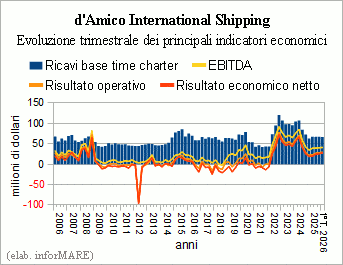
DIS therefore looks forward to a continuation of the positive phase that has begun
in the first quarter of 2026 with time charter base revenues of
$66.4 million, up +5.5% over the same period
last year, with an EBITDA of €40.9 million (+18.8%), with a
operating profit of €29.2 million (+34.1%) and with a net profit of
$27.5 million (+45.6%).



















 - Via Raffaele Paolucci 17r/19r - 16129 Genoa - ITALY


