
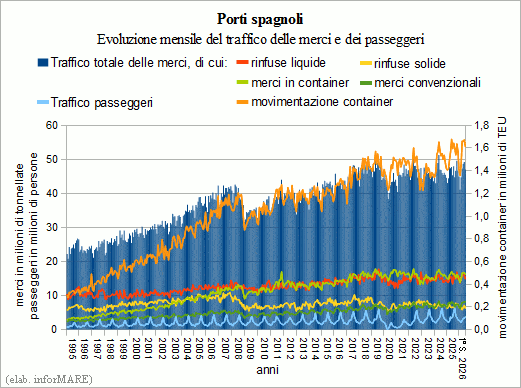
In the second quarter of this year, Spanish ports
handled a total of 144.8 million tons of goods,
with an increase of +2.9% over the same period in 2025. The increase
was primarily driven by traffic growth
of liquid bulk cargo which amounted to 47.1 million
tons (+7.2%) as well as the new historical record of
traffic of conventional goods which amounted to 24.3
million tonnes (+4.0%). Even in the sector of goods in
A new quarterly all-time high was set
which is such, however, if this flow is
Counted in terms of 20-foot containers handled:
In fact, this total is 4,953,425 TEUs, i.e. higher
by +1.8% compared to the previous historical peak of the second quarter
of 2025, while if containerized traffic is calculated
by weight, the total for the period April-June 2026 is
49.7 million tons, a volume that represents a decrease of -0.5%
on the same period last year and is far from the
record of 52.6 million tons in the fourth quarter of 2020.
Dry bulk traffic, with 19.7 million tonnes,
marked a slight increase of +0.5%.
In the second quarter of 2026, passenger traffic in the
Spanish ports was almost 10.4 million people
(-4.5%), of which 6.7 million passengers on regular lines
(-3.3%) and 3.6 million cruise passengers (-6.6%).
In the first six months of 2026, total freight traffic
was 277.7 million tonnes, with a progression
by +0.8% over the first half of last year. In the
of liquid bulk cargo was handled 91.4 million
tons (+4.8%) and in the dry bulk sector 38.2 million
tonnes (-4.0%). Containerized traffic has
amounted to 94.9 million tonnes (-1.1%) with a
container handling that has reached a new record
half-year record of 9,417,467 TEUs (+2.4%), of which 4,874,751 in
transit (+2.1%). Conventional goods totaled 45.4
million tonnes (+1.0%). In the passenger sector,
cruise passengers were almost 6.4 million (+1.8%) and passengers on the
regular services 11.2 million (-2.7%).
























 - Via Raffaele Paolucci 17r/19r - 16129 Genoa - ITALY


