Independent journal on economy and transport policy
20:38 GMT+2
PORTS
Federagenti proposes to allocate the concession fees proportionally to Ports of Italy and the Port Authorities to finance the new Spa
The federation of shipping agents promotes the government bill on port governance with reservations
Roma
June 17, 2026
Federagenti has promoted the bill with flying colors
government on port governance and the relaunch of the
investments in strategic maritime transport infrastructure,
condition that the reform favors "private investment
in ports, according to mixed finance or partnership models
public-private" and, moreover, provided that "the decisions
strategic measures adopted at national level are preceded, and then
accompanied, by a constant and punctual institutional comparison that
is not limited to involving the Port System Authorities and
other competent bodies and/or administrations, but takes care to
involve the entire complex of stakeholders in the sector
port and maritime sectors".
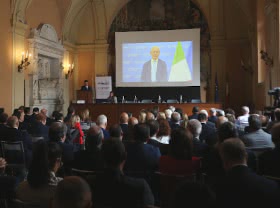
At yesterday's informal hearing at the
Transport Commission of the Chamber of Deputies, the federation
National Insurance Agency, Shipping Agents and Brokers
highlighted that, in fact, it is precisely the latter
subjects "those who are best aware of the needs of the markets,
their prospects for evolution, and can therefore provide
central indications on how to direct investments, all the more so
in a perspective of necessary selection of those who really
priority over the fiscal capacity of the State".
Confirming its appreciation for the structure and approach of the
Reform bill, Federagenti has pointed out that it considers essential
that, during the parliamentary process of examining the proposal
preserved, guaranteed and, if possible, strengthened
some aspects of the reform, first of all ensuring that this
takes place "limiting the impact on continuity as much as possible
operational activities of the ports and ongoing initiatives, in particular
infrastructural". Furthermore, according to the federation, "the
reform must safeguard the basic idea of a "direction"
on the choice of large infrastructures (not only
necessary to improve and maintain our ports on
high standards", must also encourage investment
private sector in ports and "must correct critical issues
unanimously recognized in the application of Law no. 84/1994 (two
examples; the regulation of port master plans and dredging),
and, if politically feasible, perhaps even improve
other aspects on which reflections have been made for some time (for example, the
port work, all the more so in view of the impact that
automation and artificial intelligence will also have on ports).
Finally, for Federagenti "the reform must not aggravate the
management of ports, nor to add decision-making levels:
rather, the goal must be the opposite. And in this regard, the
reform should therefore also promote a decisive uniformity
administrative practices that still appear very differentiated
depending on the Port Authority".
On the centralization of the planning of the
Strategic investments for Italian ports and the new station
sole contractor hypothesized in the reform bill, Federagenti has
expressed, as a preliminary step, agreement for the setting of the
measure "in identifying, as a central objective
port reform, the need for planning
strategic policy at national level on
new interventions and extraordinary maintenance
on the strategic transport infrastructures under the responsibility of the
Port Authority'. Furthermore, according to the federation, the attribution, for a
99 years, to Porti d'Italia Spa, the new company
for the development and promotion of the Italian network of
provided for by the Bill, "of a series of functions
aimed at the national coordination of strategic investments of
in question gives stability to the hypothetical system and,
once it has been broken in, it is suitable for guaranteeing
implementation, simplifying and rationalising certain prerogatives
exercised at the local level, and at the same time ensuring greater
Uniformity of decision-making processes and procedures
significant". "A model of this type - he explained
Federagenti - certainly seems to us suitable to reduce in a way
the decision-making and operational inhomogeneities that,
often, characterize the different local realities on these
themes, concentrating in a single highly technical and
specialized in the design and construction skills of
strategic works. A centralized model of this type appears
also consistent with the objective of resolving any
duplication, inefficiencies or disparities between operators,
benefit of the attractiveness of the system as a whole and,
therefore, of the entrepreneurial activities carried out in individual
stopovers". The federation has highlighted that it believes, however,
It is necessary that strategic decisions taken at national level
are preceded and then accompanied by a comparison also with
stakeholders in the port and maritime sector.
If the danger of exceeding both in the
forms of bureaucracy and that in the simplification of procedures,
However, Federagenti does not seem willing to ensure that the
requests of these stakeholders are effectively accepted, or
at least examined, as he considers that "an involvement
of this type, which should be implemented in the best possible way,
seen by the legislator, but with our preference for concerts
lean and non-blocking, is an element in our opinion
essential for the achievement of the objectives of
rationalization, sharing and efficiency of processes
at the basis of the reform, also with a view to multiplying the
economic effects of the investments in question, which are certainly more
effective if generated by a shared context such as the one just
described, which is also the closest
the possibility of finding private capital that
participate in the implementation of the projects". Fundamental,
For the Federation of Maritime Agents, it would therefore be the
decisions taken at central level: these are - he pointed out
Federagenti - "of an aspect that we believe is really central to the
for the purpose of identifying strategic interventions, priorities
to be awarded to them, as well as the allocation of the relevant
economic resources at local level, so as to align the
strategic decisions taken at central level (and then implemented
by Porti d'Italia S.p.A.) with the needs of the sector and respectful
of the relevant interests, precisely through that coordination
strategic "upstream" that the reform aims to create".
With regard to the centrality of decision-making power,
Federagenti believes that it is appropriate "a more complete
definition of the perimeter of investments intended as
"strategic" within the meaning of the law, and consequently
of the competences of Porti d'Italia S.p.A. in the matter, with respect to
those characterized by evaluations that, again in the
contemplated by the reform, would remain the responsibility of the local
Port Authority'.
The federation also requested clarification on the
responsibilities of Porti d'Italia Spa as the entity in charge of
'services of general public interest', in that - it has
Federagenti recalled - the Bill attributes to it "a "double
soul", which is reflected in the activities to it
intended to, namely: on the one hand, the performance, under the
concession, of services identified as "of interest
general public related to the implementation of investments
strategic works of international and national importance in
and in extraordinary maintenance ...
identified by the Plan' and 'on the other hand, the
the provision of engineering activities under market conditions,
design and construction of infrastructure works
port on behalf of third parties, where these activities do not
lead to situations of conflict of interest with respect to those
exercised by Porti d'Italia S.p.A. under the
concession".
Furthermore, Federagenti specified, "with a view to avoiding
pernicious complications, the
division of competences between Porti d'Italia S.p.A. and the Port Authority
once the works have been carried out and/or co-created as
works concessionaire". Federagenti, in fact, "believes
The risk of introducing a "hybrid" regime is very dangerous
concessions in the same port (some managed by the Port Authority, others
by Porti d'Italia S.p.A.), and therefore suggests that the second
must then return the works carried out to the competent Port Authority, the
who can then assign them through the models
procedures applicable in the legal system,
or (and where appropriate) return them to the private concessionaire,
so that these infrastructures can then be managed
according to the logic of market competitiveness, even in the
towards users".
A division of competences to which, in the opinion of
Federagenti, should obviously also correspond to a
distribution of the revenues due to the Authorities of
Port System and Ports of Italy Spa, an issue that is one of the
of the most controversial points of the government's proposal to
reform of port rules and which has recorded
the opposition of the State General Accounting Office to what shares of the
concession fees are paid to Ports of Italy: "we are
Aware - explained the Federation - that these aspects
have significant economic impacts (e.g. on the entitlement of
concession fees then paid by the concessionaires), but we believe
that these profiles can be overcome by allocating proportionally the
same fees on Porti d'Italia S.p.A. and on the Port Authority concerned".
A proposal that seems to contradict the previous suggestion
of the same Federagenti to "retrograde the works carried out
to the competent Port Authority".
- Via Raffaele Paolucci 17r/19r - 16129 Genoa - ITALY
phone: +39.010.2462122, fax: +39.010.2516768, e-mail
VAT number: 03532950106
Press Reg.: nr 33/96 Genoa Court
Editor in chief: Bruno Bellio No part may be reproduced without the express permission of the publisher






 Federagenti has promoted the bill with flying colors
government on port governance and the relaunch of the
investments in strategic maritime transport infrastructure,
condition that the reform favors "private investment
in ports, according to mixed finance or partnership models
public-private" and, moreover, provided that "the decisions
strategic measures adopted at national level are preceded, and then
accompanied, by a constant and punctual institutional comparison that
is not limited to involving the Port System Authorities and
other competent bodies and/or administrations, but takes care to
involve the entire complex of stakeholders in the sector
port and maritime sectors".
Federagenti has promoted the bill with flying colors
government on port governance and the relaunch of the
investments in strategic maritime transport infrastructure,
condition that the reform favors "private investment
in ports, according to mixed finance or partnership models
public-private" and, moreover, provided that "the decisions
strategic measures adopted at national level are preceded, and then
accompanied, by a constant and punctual institutional comparison that
is not limited to involving the Port System Authorities and
other competent bodies and/or administrations, but takes care to
involve the entire complex of stakeholders in the sector
port and maritime sectors".











 - Via Raffaele Paolucci 17r/19r - 16129 Genoa - ITALY


