
The preliminary agreement between the US and Iran for the end of hostilities,
with both parties claiming both the outcome
of the conflict than of the understanding, does not seem to have at all
disbanded the concerns of the maritime industry, and not only of
this, due to the blockade of naval traffic in the Strait of Hormuz.
The almost total naval detention is still in force and
The US administration's announcements of an imminent restoration
of transits are greeted with doubt by those responsible for the
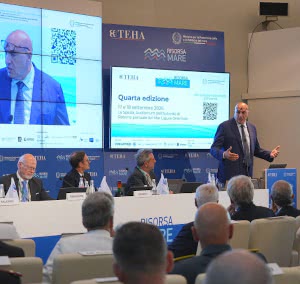
shipping. So also from the president of Assarmatori, Stefano
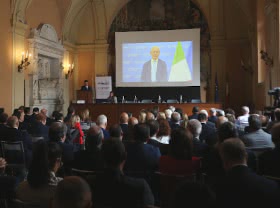
Messina, who this morning, in the course of his report
at the annual meeting of the shipowners' association held in Rome,
The news of the agreement is described as "clearly positive"
between the United States and Iran, specifying that "however, in these
months of an interruption of the conflict or at least of a
truce have been different and unfortunately the facts have never followed.
Maritime transport - Messina highlighted - needs
certainties to be able to operate safely, which is why I believe that the
ships stranded in the Persian Gulf will try to get out of it
as soon as possible, but a return to normality in the Strait
of Hormuz will not be immediate, it will take several days to
to understand if this time it will really be possible to return to navigation
with the necessary guarantees, first and foremost to protect the crews".
"While waiting to know the details of the agreement,
however - specified the president of Assarmatori - we shy away from
any hypothesis of a toll to cross the Strait, made
which would be contrary to the principle of freedom of
navigation".
If perplexities remain about an imminent return to the
normality of ship traffic through the Strait of
Hormuz, Assarmatori has no doubts about the negative impact
on the maritime industry of recent Union policies
European Union, in particular those for the decarbonisation of the
shipping with its inclusion in the European trading system
EU ETS emission allowances. "Europe - Messina denounced -
he seems to live outside of reality. It continues to tighten the
rules in force as if it were unaware of the geopolitical context and not
on the contrary, was called upon to increase competitiveness
of European companies rather than burying them. We're going
Out of the market, we cannot think of winning the competition
if the EU remains firm and within an exclusively
decided by technocrats".
"The damage generated to the automotive sector -
continued the president of Assarmatori - are evident. For the
Maritime transport We call for a bold overhaul of the system
ETS to protect the three most exposed segments: connections
with the islands, which must be excluded from this regime, the Motorways of the
Sea and container transhipment. In this context
international crisis so difficult and fragmented, Italy and
Europe remain afloat thanks to shipping and its
extraordinary ability to adapt to great upheavals
in a short time and efficiently. We cannot allow
this extraordinary economic lever is undermined by absurd
decisions taken in Brussels without the slightest trace of a
democratic confrontation and that then in Rome - Messina specified
including political decisions in the recrimination
- the funds generated by this taxation are dispersed in
thousand rivulets, instead of being intended precisely for transport
maritime for investments related to decarbonisation, such as
provides for the same Directive, and geographical constraints are laid down for
fleet renewal inspired by protectionism outside the
reality, from the market and from any commercial logic".
Messina mentioned other avenues that political decision-makers
to decarbonise the maritime industry, and in particular
nuclear energy: "We must not make a mistake
conditioned - he explained - by external factors - and look at the
facts. A number of pilot projects related to the maritime sector, with the
Generation IV nuclear power and the so-called Small Modular
Reactors, demonstrate the technical feasibility and benefits in
terms of decarbonization. The use of nuclear reactors on board
of ships also has undoubted advantages from the point of view of
logistical system, as it eliminates the need for
Supply chains dedicated to the different types of fuels
alternatives, which should be widely distributed in the
various countries to ensure fuel availability
in the operational areas of the ships".
The president of Assarmatori also focused on the
the theme of work. "It's a fact - he underlined
- that maritime labour costs are one of the main
items of expenditure for shipowners and which has a significant impact
on the competitiveness of our companies. For
For this reason, we ask, and not now, for the restoration of the
Tax relief for seafarers employed on short routes
who are all Italians. And we are talking about services that many
cases are the only and indispensable tool for mobility
for island populations and territorial continuity
of the country".















 - Via Raffaele Paolucci 17r/19r - 16129 Genoa - ITALY


