Independent journal on economy and transport policy
04:07 GMT+2
This page has been automatically translated by Original news
INDUSTRY
In 2025, LNG consumption in Italy grew by +11%, driven by industry and new uses, with the debut in the naval segment
Amadei (Federchimica's LNG Group): using ETS and FuelEU revenues to support investments and the spread of less carbon-intensive fuels
Roma
June 17, 2026
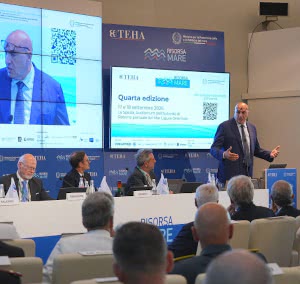
Assogasliquidi-Federchimica today presented the report "The
LNG market in 2025: state of the art and prospects for
development", carried out by BIP on behalf of the association, which
highlights a stabilisation of the Italian market, which in 2025
recorded an overall consumption of liquefied natural gas that
reached about 231 thousand tons (+11% compared to 2024), with the
automotive segment in adjustment, the industrial segment in
growth and with a naval sector that has been characterized by
from the start of the first bunkering operations at the end of the year. 'The
BIP data - explained the president of Assogasliquidi, Matteo
Cimenti - show a stabilization of consumption, although
significant growth in the industrial sector and
excellent prospects in the naval sector. The road transport sector
on the other hand, it is stable on the consumption of the previous year but with a
Slowed growth trend, despite development prospects
of absolute importance".
In detail, in 2025 the automotive sector
continued to be the largest LNG market, with approximately
75% of total consumption, but has slowed down
growth (+3%) linked to fleet renewal dynamics and
End of life of existing vehicles. During 2025, the
registrations of LNG industrial vehicles stood at
326 units, signaling a limited and insufficient recovery
to support structural demand. The industrial sector has
instead, an expansive trajectory was confirmed, with consumption equal to
about 50 thousand tons, an increasing share of the total (about 22%). The
report highlights that 2025 marked the start of the first
ship-to-ship bunkering operations, with the
still in its early stages but with high potential
growth. On the infrastructure front, three ships are operational
bunker, with a fourth scheduled for 2026. In addition, it is in
growth of the LNG fleet in Italian seas and, worldwide,
in 2025, LNG-powered ships reached 894 units,
with prospects of exceeding 1,600 by 2030.
The report identifies the maritime sector as the main driver
of future demand, potentially able to go from
less than 6 thousand tons in 2025 to 190 thousand in 2028 in the scenario
more favorable.
Dwelling on the prospects offered by the maritime sector,
the president of the LNG Group of Federchimica-Assogasliquidi, Costantino
Amadei, highlighted "how Italy, thanks to its
geographical position and the centrality of its ports, has
all the potential to become a strategic hub for
alternative fuels in the Mediterranean. To achieve this
objective - he pointed out - it is necessary to facilitate the
LNG marine bunkering operations, simplifying and
speeding up authorization and operational procedures. It is therefore
It is essential to give full and uniform implementation, in all ports
national guidelines, the guidelines released in May 2025 by the Ministry
of Infrastructure and Transport, by the General Command of the
Port Authorities and the National Fire Brigade.
Clear, homogeneous and consistently applied rules -
underlined Amadei - represent a decisive factor for
increase the attractiveness of our airports and accompany the
expected growth in the naval sector".
Referring then to bio-LNG, Amadei noted that "today
the market needs a clear regulatory and certification framework,
stable and consistent. It is indispensable - he explained -
harmonize traceability and certification tools -
from Guarantees of Origin to Proofs of Sustainability and
Chain of custody certification - overcoming uncertainties
which still hinder the development of the sector. Only through
certain rules, it will be possible to fully exploit the
contribution of bio-LNG to the decarbonisation not only of
transport, but also of numerous high-speed industrial sectors
energy intensity. In this perspective, particular
attention must be paid to the implementation phase of the
Legislative Decree 5/2026 transposing RED III".
Amadei also focused on the use of resources
generated by the EU ETS and FuelEU systems. "These tools -
said - represent an important lever to accompany the
energy transition and must be used to support
concretely the decarbonization of the sectors concerned.
Allocating these resources to infrastructure investments, innovation
and promotion of lower intensity fuels
carbon dioxide - such as LNG and, even more so, bio-LNG - is
A winning path to accelerate the achievement of objectives
climatic conditions, with particular benefit for the naval sector,
road transport and industrial transport".
- Via Raffaele Paolucci 17r/19r - 16129 Genoa - ITALY
phone: +39.010.2462122, fax: +39.010.2516768, e-mail
VAT number: 03532950106
Press Reg.: nr 33/96 Genoa Court
Editor in chief: Bruno Bellio No part may be reproduced without the express permission of the publisher







 Assogasliquidi-Federchimica today presented the report "The
LNG market in 2025: state of the art and prospects for
development", carried out by BIP on behalf of the association, which
highlights a stabilisation of the Italian market, which in 2025
recorded an overall consumption of liquefied natural gas that
reached about 231 thousand tons (+11% compared to 2024), with the
automotive segment in adjustment, the industrial segment in
growth and with a naval sector that has been characterized by
from the start of the first bunkering operations at the end of the year. 'The
BIP data - explained the president of Assogasliquidi, Matteo
Cimenti - show a stabilization of consumption, although
significant growth in the industrial sector and
excellent prospects in the naval sector. The road transport sector
on the other hand, it is stable on the consumption of the previous year but with a
Slowed growth trend, despite development prospects
of absolute importance".
Assogasliquidi-Federchimica today presented the report "The
LNG market in 2025: state of the art and prospects for
development", carried out by BIP on behalf of the association, which
highlights a stabilisation of the Italian market, which in 2025
recorded an overall consumption of liquefied natural gas that
reached about 231 thousand tons (+11% compared to 2024), with the
automotive segment in adjustment, the industrial segment in
growth and with a naval sector that has been characterized by
from the start of the first bunkering operations at the end of the year. 'The
BIP data - explained the president of Assogasliquidi, Matteo
Cimenti - show a stabilization of consumption, although
significant growth in the industrial sector and
excellent prospects in the naval sector. The road transport sector
on the other hand, it is stable on the consumption of the previous year but with a
Slowed growth trend, despite development prospects
of absolute importance".











 - Via Raffaele Paolucci 17r/19r - 16129 Genoa - ITALY


